 WhatsApp
 sales@youcantrailer.com
 +8615203709888
What is a bulk cement tank trailer
What Is a Bulk Cement Tank Trailer?
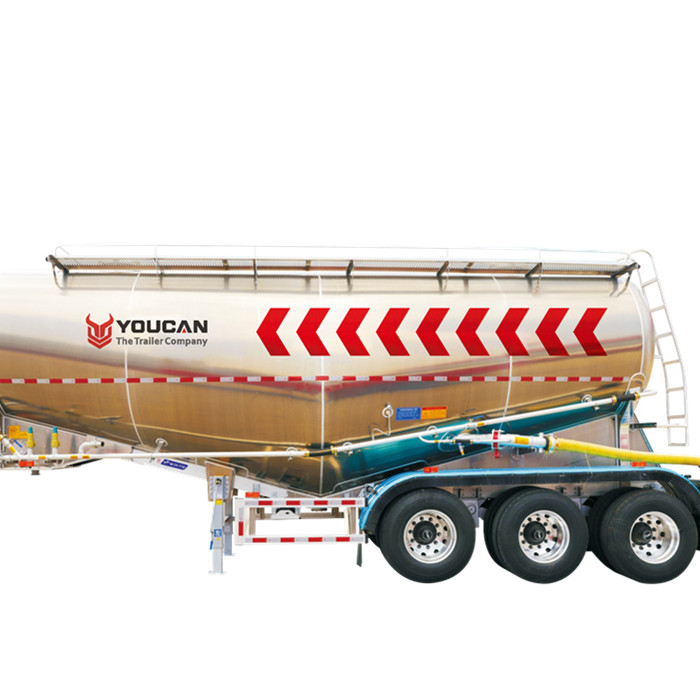
A bulk cement tank trailer is a specialized semi-trailer designed to transport dry powdered materials, particularly bulk cement, between production facilities, distribution terminals, and construction-related sites. It uses an enclosed tank and, in most conventional designs, a pneumatic discharge system to transfer material into storage silos.
Bulk cement tank trailers are also known as cement tanker trailers, pneumatic cement trailers, and dry bulk tankers. They are commonly used by cement manufacturers, ready-mix concrete producers, construction contractors, and bulk material transport companies.
Unlike trailers carrying bagged cement, a bulk cement tank trailer transports the material without individual packaging. This reduces bag handling and allows cement to be discharged directly into a compatible receiving system.
The trailer's performance depends on more than its tank size. Tank geometry, structural strength, cargo density, air supply, discharge equipment, and axle configuration all affect its suitability for a particular operation.
Main Components of a Bulk Cement Tank Trailer
A bulk cement tank trailer combines a powder-carrying tank, a load-bearing structure, and a pneumatic conveying system. Understanding these components helps buyers evaluate technical specifications and maintenance requirements.
Tank Body
The tank body stores and protects the dry powdered cargo during transportation.
Its construction must provide adequate structural strength and withstand the operating conditions specified by the manufacturer, including the pressures associated with pneumatic unloading.
Common tank materials include carbon steel and aluminum alloy. Steel is widely used for its strength and relatively economical construction, while aluminum can reduce empty vehicle weight in applications where additional payload capacity is valuable.
The tank's shape and internal arrangement also influence how material moves toward the discharge outlets.
Frame and Kingpin
The trailer frame supports the tank and transfers the load to the tractor and running gear.
The kingpin connects the semi-trailer to the tractor's fifth wheel. Its specification and installation must be compatible with the intended tractor and applicable coupling requirements.
Frame design should account for the expected operating loads, road conditions, and fatigue caused by repeated transport cycles.
Axles and Suspension
The axle and suspension system supports the trailer's weight and helps maintain stable road operation.
Bulk cement tank trailers may use different axle arrangements depending on local regulations and transport requirements. Suspension options can include mechanical leaf-spring and air-suspension systems.
The correct configuration depends on legal axle loads, road quality, maintenance resources, and the expected operating weight.
Air Compressor and Power System
The air compressor provides the compressed air required for pneumatic unloading.
Depending on the trailer configuration, the compressor may be powered by a separate diesel engine, a tractor power take-off system, or another suitable power source.
Compressor selection must account for the trailer's discharge design and the receiving system. More compressor power does not automatically guarantee faster unloading.
Air Lines, Valves, and Discharge Equipment
The pneumatic system includes air distribution lines, control valves, pressure-monitoring equipment, and discharge piping.
Some trailers also contain fluidization equipment that introduces air beneath or within the powdered material, helping it move toward the discharge outlet.
These components must work together. Poorly matched air supply, piping, or valve arrangements can cause slow discharge, material buildup, or operational problems.
For additional technical context, see YOUCAN's cement tanker trailer specification guide.
Why Are Many Bulk Cement Tank Trailers V-Shaped?
One of the most recognizable features of certain bulk cement tank trailers is their V-shaped or sloping-bottom tank design.
The purpose of this geometry is to help direct powdered material toward designated collection and discharge areas.
How the V-Shaped Design Works
In a V-shaped tank, the lower sections slope toward a central or lower discharge region.
As material leaves the tank, gravity encourages powder from the sloping sides to move toward that region. When the trailer also uses a fluidization system, compressed air helps loosen the powder and supports its movement through the discharge piping.
The result is a design intended to improve material collection and reduce areas where cargo may remain after unloading.
However, the effectiveness of the design depends on the powder's flow properties, the angle and arrangement of the tank surfaces, and the performance of the pneumatic equipment.
Benefits of a V-Shaped Tank
A properly designed V-shaped tank can offer several practical advantages:
Improved material guidance: Sloping surfaces encourage powder to move toward the discharge area.
Reduced material accumulation: Suitable geometry can help limit powder remaining in difficult-to-empty areas.
Efficient use of the discharge system: Tank shape and fluidization equipment can work together to support consistent unloading.
Simplified material collection: Directing powder toward defined outlets can make discharge management easier.
These benefits are design-dependent and should not be interpreted as guaranteed performance for every material.
Are All Cement Tank Trailers V-Shaped?
No. Bulk cement tank trailers are available with different tank geometries, including horizontal, sloping-bottom, and other specialized arrangements.
Some designs prioritize lower overall height, while others focus on tank volume, weight distribution, discharge efficiency, or particular cargo characteristics.
A V-shaped tank is therefore one engineering option rather than a universal requirement.
When comparing designs, buyers should examine the complete unloading system instead of judging performance from the tank's external shape alone.
How Does a Bulk Cement Tank Trailer Load and Unload?
Bulk cement tank trailers are designed for repeated bulk loading, road transportation, and discharge into compatible storage facilities.
Although exact procedures vary by manufacturer, the operating process generally follows three stages.
Loading the Tank
Dry cement is introduced through designated loading openings, often located on top of the tank.
Before loading, the operator should confirm that the tank is suitable for the material and that the loading system is operating correctly.
The permitted cargo weight must be calculated using the trailer's tare weight, the cargo's bulk density, and the applicable vehicle and axle-load limits.
Once loading is complete, filling openings and other closures must be properly secured for transport.
Transporting the Cement
During transportation, the enclosed tank helps protect the cargo from moisture and external contamination.
The operator must ensure that the tractor-trailer combination is correctly coupled and that the braking system, tires, suspension, lighting, and other road-safety equipment are serviceable.
Because cement is relatively dense, a tank that is not completely full may already have reached its maximum permitted payload.
Pneumatic Unloading
At the destination, the trailer's discharge system is connected to the receiving silo using compatible hoses and fittings.
The compressor supplies air to the system. Depending on the tank design, the air may fluidize the material and provide the pressure differential needed to convey it through the discharge pipeline.
The operator then manages the unloading process according to the manufacturer's specified valve sequence and pressure limits.
Several factors influence discharge performance:
Material bulk density and flow characteristics
Tank geometry and fluidization arrangement
Compressor capacity and air delivery
Discharge hose length and diameter
Pipeline bends and restrictions
Receiving silo conditions and backpressure
The system must never exceed its approved operating pressure. Before disconnecting hoses or opening tank fittings, operators must follow the manufacturer's shutdown and depressurization procedure.
For a more detailed explanation, read How to Unload a Cement Tank Trailer.
How Much Cement Can a Bulk Cement Tank Trailer Carry?
A bulk cement tank trailer's carrying capacity depends on both its physical tank volume and the weight the vehicle is legally and structurally permitted to transport.
These are two different measurements.
Tank Volume vs. Payload Capacity
Tank volume describes the internal space available for cargo, usually expressed in cubic meters (m³).
Payload capacity describes the maximum cargo weight that the trailer can carry under the relevant design and operating limits, usually expressed in kilograms or metric tons.
The relationship between volume and cargo weight can be estimated using:
Cargo Weight (tonnes) = Material Volume (m³) × Bulk Density (tonnes/m³)
For example, if a trailer contains 30 m³ of cement with an assumed bulk density of 1.2 tonnes/m³:
30 × 1.2 = 36 tonnes
This is a theoretical cargo-weight calculation, not confirmation that the trailer can legally or safely carry 36 tonnes.
Actual cement bulk density varies with the material and its condition. The correct value should be obtained from the cargo supplier or reliable operating data.
Example Capacity Calculations
The following examples illustrate how bulk density affects the estimated cargo weight.
| Material Volume | Assumed Bulk Density | Estimated Cargo Weight |
|---|---|---|
| 25 m³ | 1.2 t/m³ | 30 tonnes |
| 30 m³ | 1.2 t/m³ | 36 tonnes |
| 35 m³ | 1.2 t/m³ | 42 tonnes |
| 40 m³ | 1.2 t/m³ | 48 tonnes |
| 45 m³ | 1.2 t/m³ | 54 tonnes |
Note: These figures are illustrative calculations based on an assumed bulk density of 1.2 t/m³. They do not represent the legal or rated payload capacity of any specific trailer.
How Many Cement Bags Equal One Trailer Load?
Although a bulk cement tank trailer carries loose cement rather than bags, buyers sometimes compare its payload with the equivalent number of 50 kg cement bags.
For example:
30,000 kg ÷ 50 kg = 600 bags
A 30-tonne cement payload is therefore equivalent in mass to 600 bags weighing 50 kg each.
This comparison can help estimate delivery quantities, but it does not mean the trailer is intended to transport packaged cement.
What Should Buyers Check Before Choosing a Capacity?
Buyers should confirm:
Expected cement bulk density
Required delivery quantity per trip
Trailer tare weight and rated payload
Tractor and fifth-wheel load limits
Legal axle and gross weight restrictions
Route conditions and receiving silo capacity
YOUCAN offers different steel tank configurations, including models listed in its bulk cement tank semi-trailer product range. The appropriate model should be selected against a complete operating specification rather than tank volume alone.
YOUCAN Bulk Cement Tank Trailers: Design and Manufacturing
YOUCAN Trailer is a Chinese semi-trailer manufacturer offering bulk cement transportation equipment for international customers.
Its product range includes steel bulk cement tank semi-trailers in different volume categories, as well as aluminum tank options.
Steel Bulk Cement Tank Trailers
Steel tank trailers are widely used in cement transportation because they offer a practical balance of structural strength, manufacturing cost, and repairability.
YOUCAN lists several steel bulk cement trailer configurations, allowing buyers to compare tank volumes and vehicle arrangements according to their transport requirements.
Explore the available steel bulk cement tank semi-trailers for more information about the product range.
Aluminum Bulk Cement Tank Trailers
Aluminum tank construction can help reduce trailer tare weight compared with a comparable steel design.
This may be useful where the legal gross weight limit is fixed and reducing empty weight creates an opportunity for additional cargo.
However, aluminum construction also requires consideration of purchase cost, fabrication requirements, repair practices, and long-term operating conditions.
YOUCAN provides an aluminum bulk cement tank semi-trailer category for buyers evaluating this alternative.
Manufacturing Quality and Customization
Bulk cement tank trailers must combine sound structural fabrication with reliable pneumatic equipment.
Important manufacturing considerations include tank welding, component alignment, sealing performance, discharge-system installation, and final inspection.
When requesting a quotation, buyers should provide their cargo type, required payload, preferred tank volume, destination country, road conditions, tractor specifications, and unloading requirements.
These details help the manufacturer assess which configuration is suitable and which technical requirements must be confirmed before production.
To discuss a specific project, contact YOUCAN Trailer with your operating requirements.
FAQs About Bulk Cement Tank Trailers
Why Do Some Bulk Cement Tank Trailers Have V-Shaped Tanks?
The sloping sides of a V-shaped tank help guide powdered material toward the discharge area. Gravity and, where fitted, fluidization equipment work together to support material movement during unloading.
The actual performance depends on the complete tank and pneumatic system design.
Can a Bulk Cement Tank Trailer Carry Fly Ash?
Some bulk cement tank trailers can transport fly ash and other suitable dry powdered materials.
However, compatibility depends on the material's bulk density, flow characteristics, moisture sensitivity, and the trailer's discharge equipment. The manufacturer should confirm suitability before the trailer is used for a different cargo.
Does a Larger Tank Always Carry More Cement?
No. A larger tank provides more internal volume, but the legal payload is limited by the trailer's structural rating, tare weight, axle loads, and applicable road regulations.
For dense materials such as cement, the maximum permitted weight may be reached before the tank is full.
What Is the Difference Between a Steel and an Aluminum Cement Tank Trailer?
Steel tank trailers generally offer a lower initial material cost and established repair practices.
Aluminum tank trailers can reduce empty weight, but they may involve higher purchase costs and different repair requirements.
The best choice depends on the intended payload, operating environment, local regulations, and total ownership cost.
What Maintenance Does a Bulk Cement Tank Trailer Need?
Routine maintenance should include inspection of tank closures, seals, air lines, valves, discharge hoses, pressure-monitoring equipment, brakes, tires, suspension, and coupling components.
The compressor and other equipment must be maintained according to their manufacturers' instructions. Operators should also check for leaks, blockages, corrosion, and unusual wear.
Any work involving the tank or pressure-related components should follow the applicable safety procedures, including complete depressurization before opening the system.