20ft vs 40ft Container Chassis: How to Choose?
What is a Container Chassis Semi-trailer?
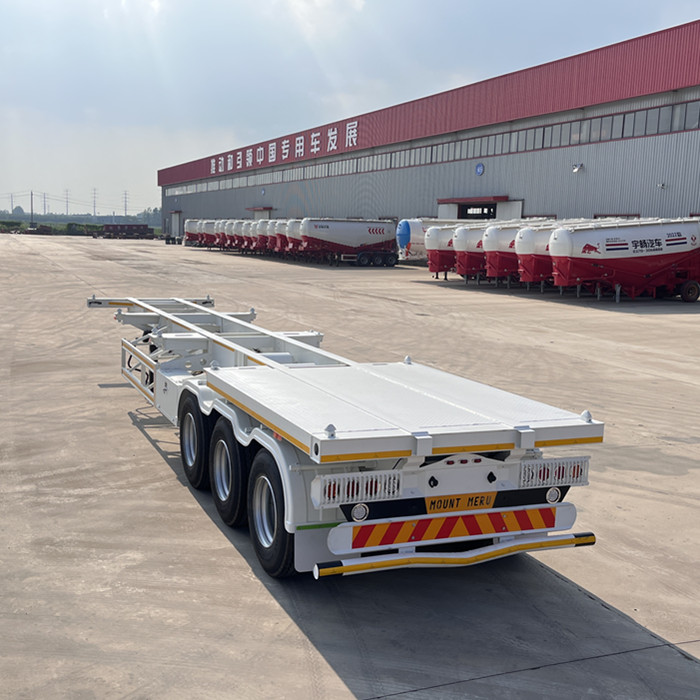
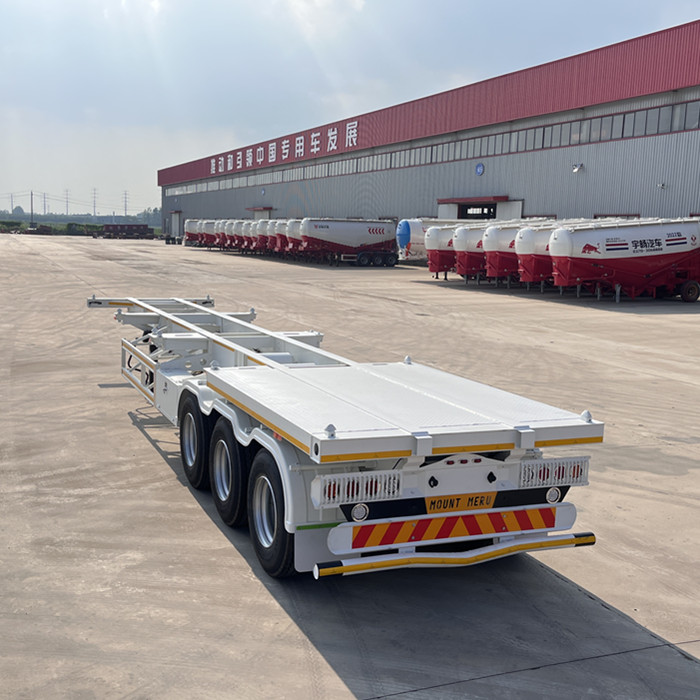
A container chassis (often called a skeletal trailer) is a highly specialized semi-trailer with a very simple but critical job. It is essentially a steel frame on wheels equipped with heavy-duty twist locks. It does not have a flat deck, walls, or a roof.
Its only purpose is to carry standard ISO shipping containers. The driver backs the chassis under a container at a port or depot, and the crane lowers the container onto the frame. The twist locks grab the four bottom corners of the container, locking it safely in place for highway transport. Because it has no heavy deck or sides, it is incredibly lightweight. This allows you to legally carry heavier loads of cargo inside the container itself.
Advantages of Using a Container Chassis Semi-trailer
Why do logistics companies rely so heavily on these skeletal trailers? Here are the biggest advantages:
Maximum Payload Capacity: Because the container itself provides the structural "box," the chassis can be built with minimal steel. This low tare weight translates directly into higher legal payload capacity. You can carry more goods per trip.
Fast Turnaround (Drop and Hook): A chassis allows for the "drop and hook" method. A tractor can drop a fully loaded chassis at a warehouse and immediately hook up to an empty one. This keeps the expensive tractor moving and earning money, rather than waiting for a container to be loaded.
Cost-Effective: Compared to a standard flatbed, a chassis is cheaper to manufacture, easier to maintain, and costs less to insure.
Port Compatibility: Ports and rail yards are designed for chassis. They are the standard equipment for intermodal drayage, fitting perfectly into the tight lanes and crane loading zones.
Types of Container Chassis Semi-trailers
Before you choose between a 20ft and a 40ft trailer, you need to know about the two main structural types of chassis available:
1. Fixed Container Chassis
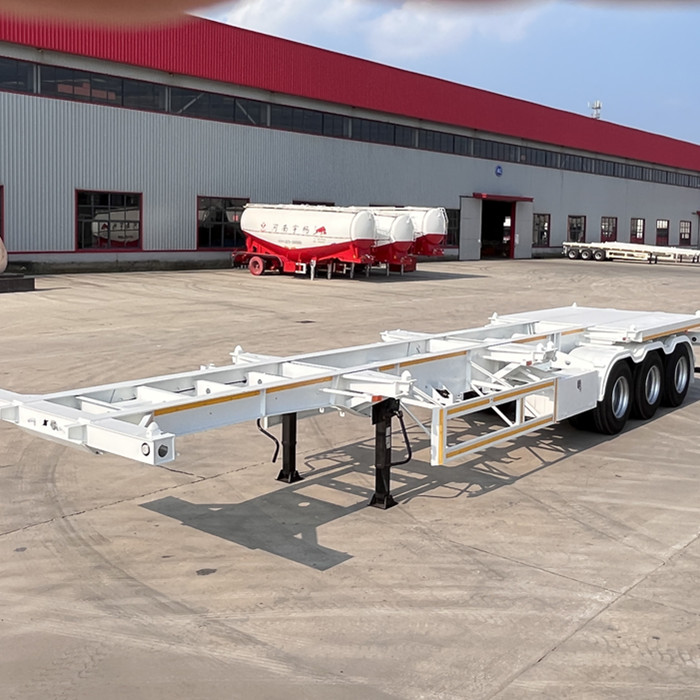
A fixed chassis is built for one specific container size. You buy a 20ft chassis, and it only carries a 20ft container. You buy a 40ft chassis, and it only carries a 40ft (or sometimes 45ft) container. These are the most common, reliable, and cost-effective options. They are lighter and require less maintenance because there are no moving parts in the frame.
2. Extendable (Slider) Container Chassis
An extendable chassis has a telescopic frame. It can be shortened to carry a 20ft container, or extended to carry a 40ft container. Many of these are also equipped with twist locks to carry two 20ft containers at once. They offer incredible flexibility for fleets that move a mix of different container sizes. However, the sliding mechanism adds weight (reducing payload) and requires more maintenance over time.
Applications and Features of Container Chassis Semi-trailers
You will see these trailers operating in a few very specific, demanding environments:
Port Drayage: Moving containers from the docks to nearby inland container depots (ICDs) or warehouses.
Rail Intermodal: Hauling containers from train terminals to their final destinations.
Depot Shuttling: Moving empty containers around massive storage yards.
To survive these harsh environments, a high-quality chassis needs specific features. The main beams must be made of high-tensile steel (like Q345B or T700) to resist bending. The twist locks must be ISO-certified and securely welded to handle the constant impact of heavy containers. Furthermore, the braking system must be top-tier—usually featuring dual-line air brakes with ABS—to ensure safe stops when hauling heavy ocean freight.
20ft vs. 40ft: How to Choose the Right Container Chassis?
Now, let's get to the core question. When you are placing an order, do you buy 20ft or 40ft chassis? Consider these four practical factors:
1. Look at Your Actual Cargo Mix
Be honest about the freight you move. If 90% of your containers are 40ft, buying a fleet of 20ft chassis makes no sense. Conversely, if your clients mostly ship heavy, dense materials like steel coils or cement, they often prefer 20ft containers because the weight limits are more manageable. If your business is split 50/50, you might want to invest in extendable chassis.
2. Consider Your Operating Routes
Where are you driving? A 20ft chassis is much shorter and more maneuverable. If you are doing urban deliveries, navigating tight construction sites, or working in congested, cramped port terminals, a 20ft chassis will save you time and reduce the risk of accidents. If you are running long-haul highway routes between cities, a 40ft chassis will yield better fuel efficiency per ton-mile.
3. Check Local Weight and Bridge Laws
Every country, and sometimes every state, has different rules about axle weight limits. A 3-axle 40ft chassis distributes weight very differently than a 2-axle 20ft chassis. If your local roads have strict bridge formulas, you must ensure the wheelbase and axle spacing of the chassis comply. Overloading is not an option; the fines will destroy your profit margins.
4. Analyze Your Budget and Timeline
Fixed 20ft and 40ft chassis are cheaper to buy and easier to maintain. Extendable chassis cost more upfront and take longer to manufacture because of the complex sliding mechanisms. If you need to expand your fleet quickly and cost-effectively, fixed lengths are the way to go.
Why It Matters: The Cost of the Wrong Choice
If you buy a 20ft chassis but your clients suddenly shift to 40ft cargo, you are stuck with unusable equipment. If you buy a 40ft chassis for tight urban jobs, your drivers will struggle to maneuver, leading to damaged equipment and wasted time. This is why consulting with your engineering team and planning your fleet configuration carefully is absolutely critical.

YOUCAN: Your Trusted Container Chassis Semi-trailer Supplier
Finding a supplier who just sells you a trailer is easy. Finding a partner who helps you build a profitable fleet is harder. YOUCAN Trailer has been manufacturing semi-trailers since 1999, bringing over 28 years of engineering expertise to the global market.
We supply a comprehensive range of heavy-haul equipment to customers in over 50 countries. Beyond our specialized Youcan Container Chassis Semi-trailer, our portfolio includes tank trailers, flatbed trailers, and lowbed trailers.
What sets YOUCAN apart is our engineering-driven approach. Our team will review your container mix, your typical routes, and your local road regulations. We then recommend the exact specifications for your fleet. We also maintain strict quality control protocols at every stage of production, ensuring every chassis we ship is built for durability, safety, and maximum earning potential.
Ready to upgrade your intermodal fleet? Contact the YOUCAN Trailer team today to get a quote and customized technical drawings within 12 hours!
FAQs about Container Chassis Semi-trailers
Can a 40ft chassis carry two 20ft containers?
Only if it is specifically equipped with twist locks in the correct positions for a "2x20ft" configuration. A standard 40ft chassis with locks only for 40ft containers cannot safely carry two 20ft boxes. You must specify this requirement when ordering.
Is a 20ft chassis cheaper to buy?
Generally, yes. A 20ft chassis requires less steel, fewer axles (usually 2 instead of 3), and fewer tires. This makes the initial purchase cheaper. However, if you are moving high volumes of freight, you might need more 20ft trailers to do the job of fewer 40ft trailers, so total fleet cost depends on your operation.
What is the difference between a container chassis and a skeleton trailer?
There is no difference. They are two different names for the exact same piece of equipment. "Container chassis" is the more common term in North America, while "skeletal trailer" is often used in Europe, Asia, and Africa.
Do I need a 3-axle chassis for a 20ft container?
Not always. A standard 2-axle 20ft chassis is perfectly fine for most normal payloads. However, if you are carrying extremely heavy, dense materials (like wet sand or heavy steel) and local regulations allow it, a 3-axle 20ft chassis can provide better weight distribution and braking stability.
What is the typical lead time for manufacturing a custom chassis?
Standard models typically take about 15 to 25 working days after deposit confirmation. If you require custom axle spacing, specific paint colors, or extendable frames, the lead time may be slightly longer. We confirm the exact production schedule before you place your order.
What Are the Main Components of a Semi Trailer?
The main components of a semi trailer include the frame, deck or body, kingpin and landing gear, axles, suspension, wheels and tires, braking and air ...
Read More →
What Is a Tipper Semi Trailer?
Discover what a tipper semi trailer is, how it works, and how to choose the right rear or side tipper for your fleet.
Read More →