How to Choose a Heavy Duty Flatbed for Steel Coils?
1. Introduction and Executive Summary
A heavy duty flatbed is the working link between your steel mill or service center and your customers. The wrong specification causes overload fines, coil edge damage, slow loading and early structural fatigue. The right one protects cargo quality and keeps cost per tonne-kilometer low for years.
Steel coils are dense, concentrated loads that can shift. A trailer built for general cargo will often struggle with them, so the specification needs to start with the coil, not the catalog.
Buyer's Quick Checklist
- Coil data: weight range, outside diameter, width and coil count per trip.
- Payload and axle rating: legal gross weight in your destination market, with a safety margin.
- Deck design: flat deck with coil cradles, or a recessed trough.
- Securing system: anchor points, headboard, chains and friction mats.
- Documentation: material certificates, test reports and export paperwork.
2. Key Factors and Technical Parameters to Consider
Define these six parameters before you request any quotation. They determine most of the price and almost all of the performance.
Payload and Gross Weight
- Flatbed payload capacity equals the permitted gross vehicle weight minus the trailer tare weight. A lighter trailer carries more steel per trip, but only if the structure remains adequate.
- Check the legal axle-group limits in your country, not just the trailer's nameplate figure.
- Coils are often 10 to 30 tonnes each, so confirm how weight is distributed along the deck.
Axle Rating and Suspension
- The heavy duty trailer axle rating is commonly 13 tonnes per axle for tri-axle layouts. Confirm the brand, hub type and brake size.
- Mechanical suspension handles rough yards and is simple to maintain. Air suspension protects coil surfaces on long, smooth routes.
- Specify ABS or EBS braking where regulations require it.
Frame and Deck Structure
- Main beams made from high-tensile steel resist fatigue under concentrated coil loads.
- Look for reinforced cross members under the coil positions and a deck that can take point loads.
- Ask for the main beam height, web and flange thickness, and the weld process.
Coil Positioning Features
- Coil orientation matters: eye-to-sky coils need cradles or a trough, while eye-to-side coils need bolsters and stops.
- Specify the coil diameter range so the cradle angle and height fit your product.
Securing Points and Headboard
- Anchor points should have a clearly marked working load limit (WLL).
- A headboard or bulkhead protects the tractor cab during hard braking.
- Choose your restraint method early, because it affects the deck layout.
Operating Environment
- Coastal or de-icing salt routes call for stronger corrosion protection, such as shot blasting and an epoxy primer.
- Check ground clearance, kingpin height and landing gear capacity against your yard conditions.
3. Types of Heavy Duty Flatbed: Which One Fits Your Needs?
Most buyers choose among four configurations. The table below compares them for coil work.
| Type | Key Specs | Price Level | Best Used For |
|---|---|---|---|
| Standard flatbed with removable cradles | 2-3 axles, flat deck, anchor rails, cradles fitted as needed | Low to medium | Mixed loads where coils are occasional |
| Dedicated coil trailer with fixed trough | Recessed trough, reinforced cross members, headboard | Medium to high | Regular eye-to-sky coil transport |
| Drop-deck or lowbed | Lower deck height, higher payload per cubic height | Medium to high | Tall coils and bridge-height restrictions |
| Interlink (tandem) flatbed | Two linked units, higher combined payload | High | Long-haul, high-volume steel distribution |
If you ship coils alongside plates, beams and pipes, our Flatbed Trailers range offers flexible decks. For linked, high-volume operations, see the Interlink Flatbed Trailer. For tall coils or height-limited routes, Lowbed Trailers are worth comparing.
4. Essential Features and Quality Standards
Two trailers can look identical and perform very differently. These are the details that separate them.
Components That Separate Good from Poor
- Steel grade and traceability: request mill certificates for the main beams.
- Welding quality: automated welding on main seams gives more consistent penetration.
- Axles and brakes: use recognized brands, with matching hubs and bearings.
- Surface treatment: shot blasting, primer and topcoat thickness should be specified in microns.
- Lighting and wiring: sealed connectors and protected harnesses reduce roadside failures.
Certifications and Standards
- ISO 9001 for the manufacturer's quality management system.
- CE or regional type approval where required by the destination market.
- EN 12195-1 as the reference for load-securing calculations.
- RoHS compliance for electrical components where applicable.
Always ask which certificates apply to your market. Requirements differ between regions.
5. Total Cost of Ownership (TCO) and Budgeting Guide
Upfront vs. Ongoing Costs
- Purchase price: the trailer, options, spare wheel and toolkit.
- Shipping and import: freight, insurance, duties and local registration.
- Maintenance: greasing, brake service, tire replacement and wheel-end inspection.
- Spare parts: keep a stock of wear items. Standardized Trailer Parts reduce downtime.
- Downtime: a day off the road can cost more than a year of greasing.
Justifying the Investment
Frame the case around cost per delivered tonne. A trailer that is 500 kg lighter but equally strong adds payload on every trip. A purpose-built coil deck reduces damaged edges and shortens loading time.
Compare two or three options using expected trips per year, payload difference, maintenance interval and resale value. Management responds well to a payback period rather than a price comparison alone.
6. Top Common Buying Mistakes and How to Avoid Them
- Chasing the lowest price. Thin beams and unbranded axles often cost more over time. Compare specifications line by line.
- Over-specifying. A trough trailer is unnecessary if coils are only occasional. Match the design to real usage.
- Ignoring local regulations. Axle spacing, overall length, lighting and brake systems must meet destination rules.
- Skipping the securing plan. Knowing how to secure steel coils on a flatbed should shape the deck. Confirm the number of chains or straps, their WLL, and the use of friction mats and wedges.
- Overlooking supplier support. Check parts availability, drawings and technical response times before you pay a deposit.
7. Customization and OEM/ODM Options
Steel logistics differs by country and product, so flexibility matters. Typical options include:
- Structural changes: deck length, coil trough dimensions, bolster position and headboard height.
- Axle and suspension choice: axle count, brand, mechanical or air suspension.
- Securing hardware: extra anchor points, winch positions, side posts and tool boxes.
- Electrical adaptation: 12V or 24V systems and regional connector types.
- Branding: custom paint color, logos and reflective markings.
If you operate a mixed fleet, you can also look at our Stake Semi Trailer for bulky, non-coil cargo. Send drawings or loading photos, and engineers can review the layout.
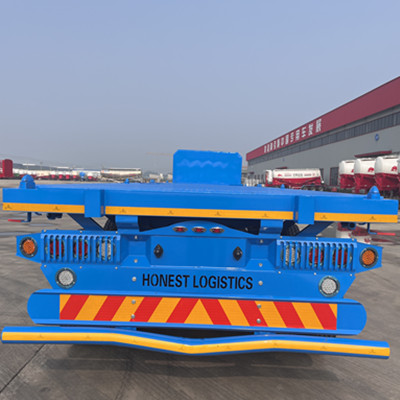
8. Inspection, Packaging and Shipping
Pre-Shipment Inspection
- Dimensional check against the approved drawing.
- Weld inspection, coating thickness measurement and paint finish review.
- Brake, air line and lighting function tests.
- Kingpin and landing gear check, plus a final photo or video report for the buyer.
Packaging and Loading
- Trailers can ship by RoRo, flat rack, open top or in containers, depending on size and port.
- Loose parts are packed in fumigation-free wooden crates or plywood cases, with moisture-proof wrapping and desiccant.
- Axles, wheels and lights are protected against scratches and sea moisture.
Shipping Terms
- FOB: the seller delivers to the port of loading. The buyer arranges freight and insurance.
- CIF: the seller covers freight and minimum insurance to the destination port.
- DDP: the seller handles delivery to the buyer's door, including duties, where permitted.
Choose the term that matches your import experience and local clearance capability.
9. Why Partner with Us as Your Manufacturer?
We build semi-trailers for demanding freight, from steel and machinery to bulk materials and liquids. Our range includes Flatbed Trailers, tippers and tank units, so you can standardize your fleet with one supplier.
- Engineering support: we review your coil sizes, routes and regulations before quoting.
- Quality control: inspection at material intake, welding, painting and final assembly.
- Scheduled delivery: production timelines are confirmed at order and updated with progress photos.
- Warranty and support: structural and component warranty terms are stated in the contract, with parts and technical guidance after delivery.
10. Frequently Asked Questions (FAQ)
What is the minimum order quantity (MOQ)?
One unit is usually acceptable for standard models. Custom designs or fleet pricing may require a larger order, so confirm your target quantity with the sales team.
What is the typical lead time?
Lead time depends on specification, order volume and production schedule. Standard configurations are quicker than custom coil trough designs. A confirmed delivery date is provided with the proforma invoice.
What warranty is provided?
Warranty covers manufacturing defects in the frame and workmanship for a defined period. Purchased components such as axles and tires follow their suppliers' terms. The exact period is stated in the sales contract.
What payment terms are available?
Common terms are a T/T deposit with the balance before shipment, or an irrevocable L/C at sight. Terms are agreed per order.
What after-sales service can I expect?
We provide technical documents, parts lists and remote troubleshooting. Wear parts and spare components can be shipped on request, so your trailer returns to service quickly.
To get selection advice for your coil sizes and routes, send your payload target and loading drawings to our team and request a quotation.
What Is a Flatbed Truck Trailer Used For?
Discover the primary uses and applications of a flatbed truck trailer across construction, logistics, and manufacturing. Get detailed specifications a...
Read More →
How to Choose a 20ft Container Chassis for Port Drayage
Learn how to choose a 20ft container chassis for port drayage: specs, types, TCO, and common mistakes. Request a quote or selection advice from our te...
Read More →