How to Choose a 20ft Container Chassis for Port Drayage
1. Introduction and Executive Summary
A 20ft container chassis looks like a simple steel frame, yet it directly affects turnaround time at the terminal, tire and brake costs, cargo safety, and legal compliance on every trip. A poorly matched unit means overweight fines, slow gate processing, and unplanned downtime. A well-matched one lowers cost per move for years.
This guide is written for procurement managers, fleet owners, and distributors who need a practical, objective framework for buying in volume.
Buyer's Quick Checklist
- Confirm maximum gross weight and axle load limits in your operating country.
- Match the axle count (2 or 3) to your typical cargo density.
- Check the twist-lock layout and ISO 668 corner-casting compatibility.
- Verify kingpin size, landing gear rating, and tractor coupling height.
- Ask for steel grade, weld inspection records, and brake system brand.
- Compare total cost of ownership, not only the ex-works price.
2. Key Factors and Technical Parameters to Consider
Before comparing quotations, define your duty cycle: terminal-to-yard shuttles, short-haul inland trips, or mixed on-road and off-road work. The following parameters then become your evaluation baseline for any 20 foot container chassis.
Load Capacity and Weight Limits
- Payload and gross weight: A 20ft container is often loaded with dense cargo, so check the chassis rating against the heaviest container you will carry. Typical designs support a total container weight of about 30 to 36 tonnes depending on axle configuration and local rules.
- Tare weight: A lighter frame allows more payload within legal limits, but never at the expense of structural strength.
Frame Structure and Materials
- Main beams: Look for high-tensile structural steel (for example Q345B or equivalent) with a proper I-beam or welded section design.
- Fatigue resistance: Port work involves repeated stacking, hard braking, and uneven yards, so weld quality and cross-member spacing matter.
Axles, Suspension, and Brakes
- Axle rating: 12 to 13 tonne axles are common. Choose a recognized axle brand with traceable test records.
- Suspension: Mechanical leaf-spring suspension is rugged and low-maintenance. Air suspension gives better cargo protection and ride height control.
- Braking: Dual-line air brakes with ABS or EBS are standard in many markets. Confirm the system meets local regulations.
Coupling, Landing Gear, and Locks
- Kingpin: A 50 mm (2 inch) kingpin is the common standard. Confirm compatibility with your tractors.
- Landing gear: Check static and dynamic ratings, as well as the gear's operating clearance.
- Twist locks: A standard 20ft layout uses four locks. Confirm whether they are fixed, flip-up, or retractable.
Operating Environment
Coastal terminals demand stronger anti-corrosion coatings. Hot climates require careful tire selection, and rough yards benefit from reinforced cross-members and heavy-duty fenders.
3. Types of 20ft Container Chassis: Which One Fits Your Needs?
The right choice depends on cargo weight, route, and whether your fleet also moves 40ft boxes. Our Container Chassis range covers the main structures below.
| Type | Key Specs | Price Level | Best Used For |
|---|---|---|---|
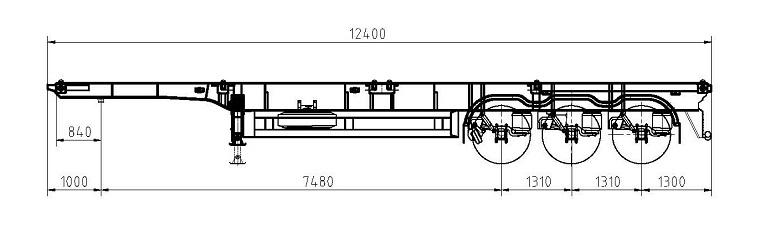
| 2-Axle 20ft Skeleton Chassis | Two 12-13t axles, four twist locks, low tare weight | Low to medium | Standard port drayage, short-haul 20ft loads |
| 3-Axle 20ft Skeleton Chassis | Three axles, higher gross rating, better load distribution | Medium | Heavy bulk cargo in 20ft boxes, strict axle-load regions |
| Extendable 20/40ft Combo Chassis | Telescopic frame, multiple lock positions | Medium to high | Mixed fleets handling both 20ft and 40ft containers |
| Flatbed-Style Container Trailer | Full deck with twist locks, can carry general cargo | Medium | Operators needing container and break-bulk flexibility |
| Lightweight Air-Suspension Chassis | Air suspension, reduced tare, EBS option | Medium to high | Fragile cargo and long-distance inland runs |
If you also need deck flexibility, compare these with our Flatbed Trailers before finalizing your fleet mix.
4. Essential Features and Quality Standards
Two chassis can look identical in a photograph and perform very differently after 18 months. These are the points that separate durable units from low-tier ones.
- Welding quality: Continuous, even welds with robotic or qualified manual processes, plus visual and dimensional checks.
- Surface treatment: Shot blasting, primer, and topcoat for corrosion resistance. Hot-dip galvanizing or heavier coating systems help in coastal climates.
- Components: Branded axles, brake chambers, valves, and tires with documented origin.
- Electrical system: Sealed connectors, 24V lighting, and protected wiring harnesses.
- Twist-lock quality: Forged or high-strength castings with smooth operation and clear locked indicators.
Certifications and Compliance
Ask for an ISO 9001 quality management system certificate, material test reports, and any approvals required in your destination market, such as CE, ECE braking and lighting compliance, or local type approval. Certificate availability varies by model and market, so request documentation early.
5. Total Cost of Ownership (TCO) and Budgeting Guide
The purchase price is only part of the cost. For a drayage operator, ongoing expenses often exceed the initial price over a typical service life.
Upfront and Ongoing Costs
- Upfront: Chassis price, options (air suspension, ABS/EBS, special paint), freight, insurance, and import duties.
- Maintenance: Tires, brake linings, bearings, lubrication, and lighting. Standard Trailer Parts shared across your fleet reduce stock complexity.
- Downtime: Every day a chassis is off the road costs revenue and may delay container returns.
- Fuel: A lower tare weight and good tire selection can reduce fuel consumption per trip.
- Compliance: Re-inspection, repairs after audits, and fines for overload or defective brakes.
Justifying the Investment
Present management with cost per container move rather than a unit price comparison. A slightly higher-spec chassis with stronger welds, better coatings, and common spare parts frequently lowers cost per move through fewer breakdowns and longer service life. Include a spare-parts package in the first order to protect early uptime.
6. Top Common Buying Mistakes and How to Avoid Them
- Chasing the lowest price. Thin steel, unbranded axles, and weak coatings shorten life. Request a component list with brands and specifications in the quotation.
- Ignoring local weight regulations. A chassis legal in one country can be overweight in another. Confirm axle load and gross limits first.
- Over-specifying. Three axles and air suspension are unnecessary for light, short-haul loads. Match the specification to your real duty cycle.
- Overlooking tractor compatibility. Kingpin position, coupling height, and air or electrical connectors must match your prime movers.
- Neglecting after-sales support. Confirm warranty terms, spare-part availability, and technical response time before signing the contract.
7. Customization and OEM/ODM Options
Standard models suit many fleets, but a practical customization can save time and money later. Typical options include:
- Dimensions and structure: Frame length, twist-lock positions, and reinforcement for heavy-duty yards.
- Axle and suspension layout: Two or three axles, mechanical or air suspension, and axle brand preference.
- Electrical and braking systems: Voltage, connector standards, ABS or EBS, and regional lighting requirements.
- Branding: Custom paint color, logo, reflective markings, and serial plates.
- Accessories: Spare wheel carrier, toolbox, mudguards, and rear bumper.
For wider fleet planning, you can also review our Interlink Trailers and other semi-trailer ranges. Sending drawings or a target specification helps speed up engineering review.
8. Inspection, Packaging, and Shipping
Pre-Shipment Inspection
Before dispatch, each unit should be checked for dimensions, weld quality, paint thickness, brake function, lighting, and twist-lock operation. Buyers can request inspection photos, videos, or a third-party inspection report.
Export Packaging and Loading
Chassis are commonly shipped in containers, flat racks, or by Ro-Ro and break-bulk vessels depending on quantity and destination. Wheels, landing legs, and electrical connectors are protected, and loose parts are packed in fumigation-free wooden crates or sturdy cartons with moisture-proof wrapping. Lashing points and blocking are planned to prevent movement at sea.
Shipping Terms
- FOB: Seller delivers goods on board at the origin port. Buyer handles ocean freight and insurance.
- CIF: Seller covers freight and insurance to the destination port. Local charges stay with the buyer.
- DDP: Seller handles delivery including import clearance and duties, where this is feasible for the destination country.
9. Why Partner with Us as Your Manufacturer?
We design and manufacture semi-trailers for export markets, including skeleton chassis, tank, tipper, and general cargo models. Buyers value predictable specifications and clear communication.
- Factory capability: In-house cutting, welding, assembly, and painting, with engineering support for modified specifications.
- Quality control: Incoming material checks, in-process welding inspection, and final testing before delivery.
- Delivery: Production planning aligned to your schedule, with regular progress updates.
- Warranty and support: Defined warranty terms, spare-parts supply, and technical guidance for operation and maintenance.
If your project also involves other vehicle types, you can browse our General Cargo Semi Trailers for complementary options.
10. Frequently Asked Questions (FAQ)
What is the minimum order quantity for a 20ft container chassis?
MOQ depends on model and customization level. Many standard models can be ordered in small quantities or as a trial unit. Larger orders normally improve unit pricing and production scheduling.
What is the typical lead time?
Standard configurations usually take a few weeks from deposit to completion, while customized units take longer. Confirm the schedule against your quantity, specification, and shipping slot.
What warranty is offered?
Warranty terms are set in the contract and usually cover the frame and manufacturing defects for a defined period. Wear parts such as tires and brake linings are normally covered separately by their component makers.
What payment terms are accepted?
Common terms are T/T with a deposit before production and the balance before shipment, or an irrevocable L/C at sight. Exact terms are agreed per order.
What after-sales service is available?
Support typically includes spare-part supply, installation guidance, troubleshooting by phone or email, and documentation for operation and maintenance.
Send us your target gross weight, axle preference, and destination country, and our team will recommend a suitable configuration and prepare a quotation. You can also submit drawings for review.
How to Choose a Heavy Duty Flatbed for Steel Coils?
Choose a heavy duty flatbed for steel coils with this buyer's guide to payload, axles, coil cradles, TCO and export shipping. Ask for selection advice...
Read More →
What Is a Flatbed Container Trailer Used For?
Discover the primary uses, types, and key features of a flatbed container trailer. Our comprehensive guide helps B2B buyers make informed purchasing d...
Read More →