What Is a Container Chassis Trailer?
What is a Container Chassis Trailer?
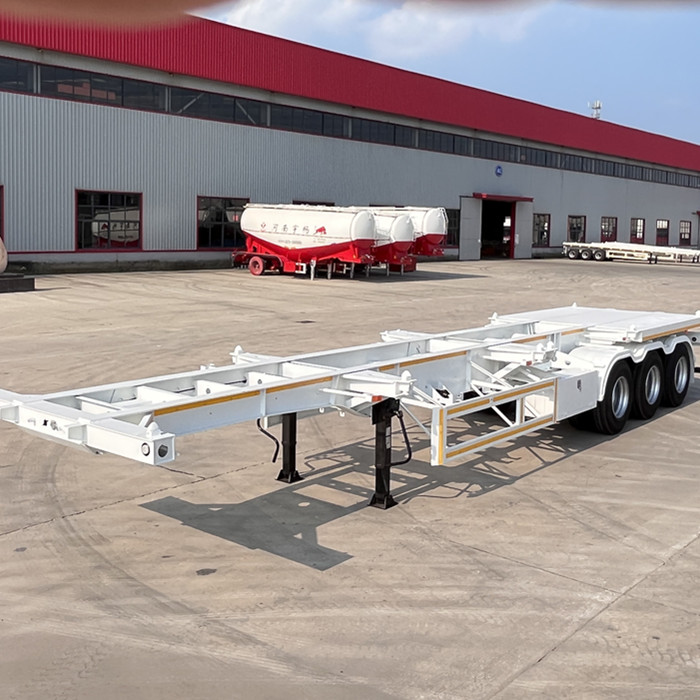
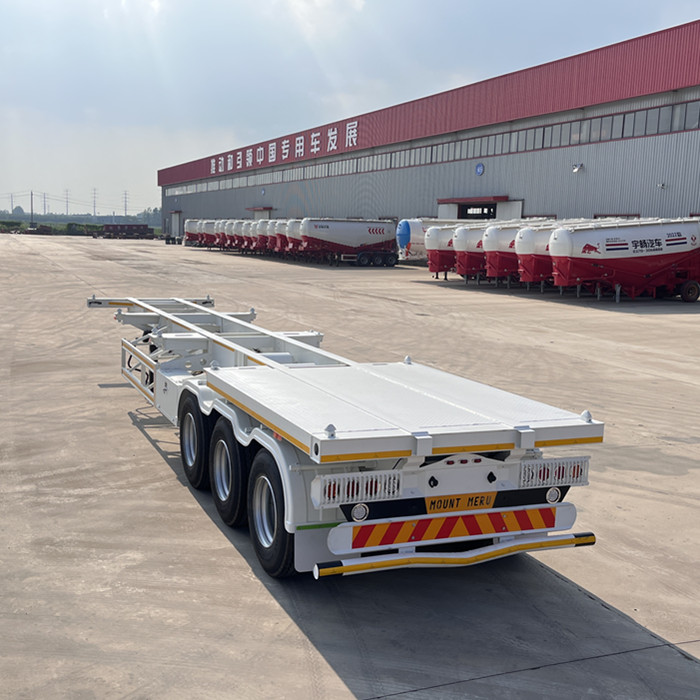
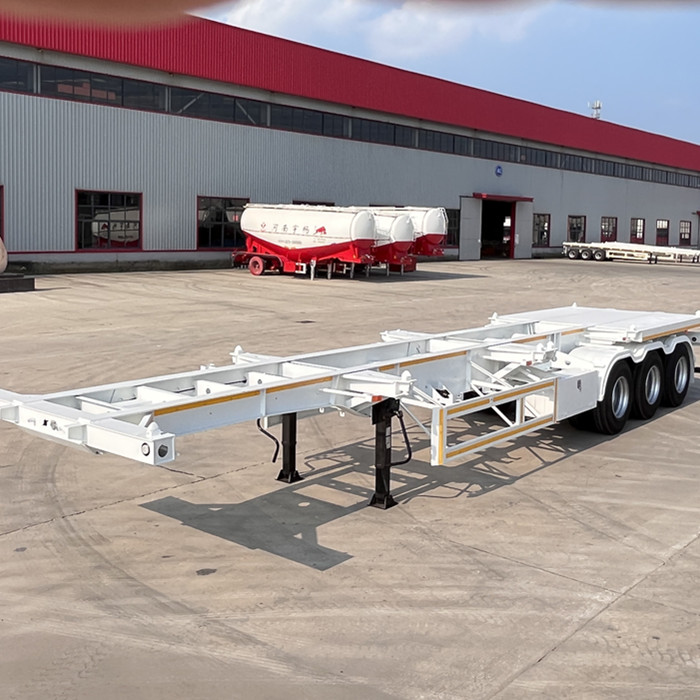
A container chassis trailer (often referred to simply as a chassis or a skeletal trailer) is a highly specialized piece of heavy-duty equipment designed with one single purpose: to carry standard ISO shipping containers over the road.
Unlike a standard box van or a flatbed, a container chassis does not have a full floor deck, side walls, or a roof. It is essentially a robust steel frame mounted on axles and wheels. It is equipped with twist locks at precise locations along the frame. When a crane lowers a container onto the chassis, these twist locks engage with the corner castings of the container, locking it securely in place for highway transport.
Because the container itself provides the structural "box" for the cargo, the chassis can be built incredibly light. This saves fuel and allows the truck to legally carry heavier loads inside the container.
How Does a Container Chassis Trailer Work?
The operation of a container chassis is a straightforward process known as "intermodal drayage."
Coupling: The chassis connects to a tractor unit via a heavy-duty kingpin. The tractor supplies the power, air for the brakes, and electrical connections.
Loading: The driver positions the bare chassis under a crane at a port or rail yard. The crane lowers the container onto the frame. The operator manually engages the four (or more) twist locks to secure the load.
Transit: The loaded trailer travels from the port to a warehouse or inland container depot. The skeletal design keeps the center of gravity low, ensuring stability on the highway.
Unloading (Drop and Hook): At the destination, the twist locks are released, and the container is lifted off. The tractor can then hook up to a different chassis, maximizing the use of the expensive tractor unit.
Advantages of a Container Chassis Trailer
Why is this skeletal design the global standard for moving shipping containers? Here are the main advantages:
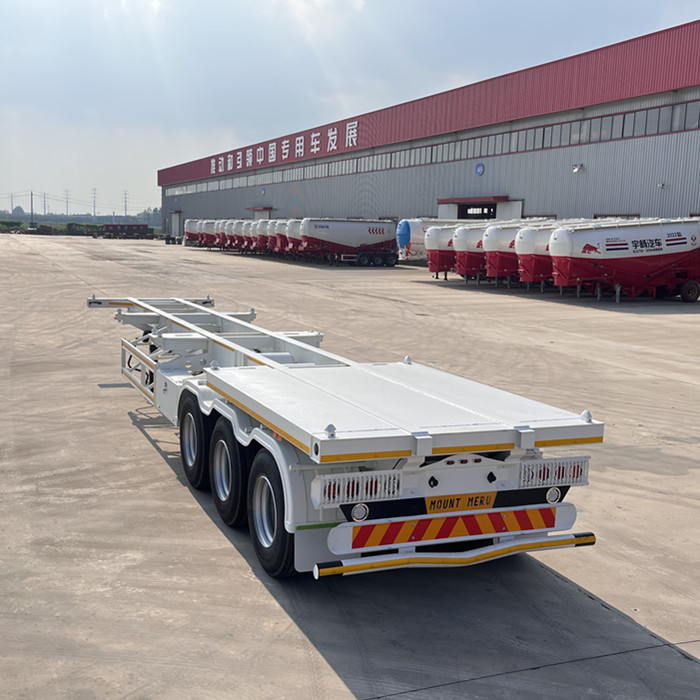
Maximum Payload Capacity: Because it lacks a heavy deck, walls, and a roof, the chassis has a very low tare weight. This means more of the legal weight limit can be used for actual cargo.
Extreme Versatility: Most modern chassis are equipped with multiple sets of twist locks. This allows a single 40ft chassis to carry one 40ft container, two 20ft containers, or even a 45ft container.
Cost-Effective Fleet Management: Chassis are cheaper to purchase and maintain than enclosed vans. The "drop and hook" method also means you do not need as many tractors as you do trailers.
Fast Turnaround: The simple design makes loading and unloading incredibly fast, drastically reducing port congestion and keeping supply chains moving.
Main Components of Container Chassis Trailers
A high-quality container chassis is built to withstand the harsh environment of ports and heavy highway use. Its core components include:
High-Tensile Steel Main Beams: The main longitudinal beams are typically made from Q345B or T700 steel. They are welded using automated submerged-arc welding to ensure maximum structural integrity under heavy loads.
ISO Twist Locks: These are the most critical components. They must be forged from high-strength steel to securely lock into the container's corner castings without the risk of breaking loose under stress.
Heavy-Duty Suspension: Many chassis use mechanical leaf spring suspension for durability, though air suspension is available for a smoother ride and adjustable height.
Reliable Braking System: A dual-line pneumatic air brake system with ABS (Anti-lock Braking System) is standard, ensuring safe stops even when hauling a fully loaded 40ft container.
Auxiliary Equipment: Practical features often include a steel toolbox, spare tire carriers, and side underrun protection guards for road safety.

Types and Specifications of Container Chassis Trailers
When buying a container chassis, you will encounter a few distinct structural types and configurations:
Fixed-Length Chassis: Built for a single size (either 20ft or 40ft). They are lighter and simpler but lack flexibility if your container sizes change.
Extendable (Slider) Chassis: Feature a telescopic frame that can be retracted for a 20ft container or extended for a 40ft container. Highly versatile but heavier and more expensive.
Gooseneck Chassis: Feature a lowered front section to reduce the overall height, which is useful for hauling high-cube containers or complying with strict bridge laws.
Axle Configurations: Typically available in 2-axle (standard for 20ft), 3-axle (standard for 40ft), or heavy-duty tri-axle setups for maximum payload.
Applications of Container Chassis Trailers
These specialized trailers are the backbone of global intermodal logistics. You will primarily find them operating in the following environments:
Port Drayage: Moving containers from the docks to nearby inland container depots (ICDs) or distribution centers. This is the most common application.
Rail Intermodal: Hauling containers from train terminals to their final destinations. The chassis bridges the gap between the rail network and local warehouses.
Depot Shuttling: Moving empty containers around massive storage yards. The lightweight design and tight turning radius make them ideal for this task.
Cross-Border Freight: Moving international shipping containers across national borders (where regulations permit).
Common Buyer Mistakes
When evaluating a manufacturer, avoid these common pitfalls regarding welding quality:
Judging weld quality only by bead appearance or a single production photograph.
Asking for a certificate without asking which joint or process it covers.
Ignoring fit-up, distortion, and structural geometry because the welds look smooth.
Demanding NDT everywhere without matching the method to the joint and risk profile.
Failing to define how repaired or rejected welds will be handled, documented, and re-inspected before shipment.
What Buyers Should Ask the Manufacturer
To ensure your investment is protected, smart buyers should ask these critical questions before placing an order:
Which approved drawing or configuration is the quotation based on?
Which dimensions, functions, and interfaces are critical for my operation?
How will the welding be inspected before shipment, and what records will be provided?
Which parts require destination-specific confirmation (e.g., lighting or braking laws)?
What changes would require an engineering review after order approval?
Why YOUCAN Trailer is Your Ideal Supplier
As a leading professional semi-trailer manufacturer established in 1999, YOUCAN Trailer brings over 28 years of engineering expertise to the global market. We specialize in providing tailored transport solutions to customers across Africa, the Middle East, South America, and Southeast Asia.
Our diverse portfolio covers every aspect of heavy haulage, including flatbed trailers, lowbed trailers, tank trailers, and General Cargo Semi Trailers, allowing fleet operators to source their entire equipment lineup from a single trusted partner.
We invite you to take a factory tour to see our advanced CNC cutting and submerged-arc welding lines in person. Our strict quality control protocols ensure every chassis is built to withstand the rigors of the port. What sets YOUCAN apart is our commitment to customization; our engineering team reviews your container sizes, your routes, and your local regulations to recommend the best twist lock configuration and axle spacing.
Ready to upgrade your intermodal fleet? Contact the YOUCAN Trailer team today to get a quote and technical drawings within 12 hours!
FAQ
What is the difference between a container chassis and a skeleton trailer?
There is no difference. Both terms refer to the exact same piece of equipment. "Container chassis" is the preferred term in North America, while "skeletal trailer" is more common in Europe and Asia.
Can a 40ft chassis carry two 20ft containers?
Only if it is specifically equipped with twist locks in the correct positions for a 2×20ft configuration. Not all 40ft chassis have this feature, so you must specify it when ordering.
Do I need a 3-axle chassis for a 20ft container?
Not usually. A 2-axle 20ft chassis is sufficient for standard loads. However, if you are hauling extremely dense, heavy materials, a 3-axle configuration may be required or preferred for better weight distribution.
What kind of steel is used for the chassis main beams?
High-quality chassis use high-tensile steel (such as Q345B or T700) for the main beams. This provides the strength to carry heavy containers while keeping the trailer weight low.
Are these trailers suitable for rough road conditions?
Container chassis are generally designed for paved highways and port terminals. If you need to operate on unpaved or rough roads, you should request reinforced suspension and higher ground clearance.
What Is the Difference Between a Fuel Tank Trailer and a Cement Tank Trailer?
A fuel tank trailer carries liquid fuel in a tank system designed around liquid containment, compartmenting, vapour control, grounding, emergency equi...
Read More →
What Are the Main Components of a Semi Trailer?
The main components of a semi trailer include the frame, deck or body, kingpin and landing gear, axles, suspension, wheels and tires, braking and air ...
Read More →