Reduce Empty Miles With a 20ft Container Chassis
In global logistics and heavy industry, operational efficiency is paramount. The strategic deployment of specialized equipment can dramatically reduce waste, lower operational costs, and improve turnaround times. The 20ft container chassis is a cornerstone asset for achieving these goals, serving as a highly efficient and versatile solution for transporting 20-foot ISO containers across a multitude of sectors. This guide provides an in-depth look at the applications, specifications, and selection criteria for this essential piece of port drayage equipment.
| Target Industry | Primary Material / Component | Key Benefit / Value Delivered |
|---|---|---|
| Logistics & Port Drayage | High-Strength Steel (Q345B/S355JR) | Accelerated container turnaround, reduced empty miles |
| Intermodal Transport | ISO-compliant Twist Locks | Seamless transfer between ship, rail, and road |
| Manufacturing & Distribution | Reinforced Main Beams | Reliable on-site and last-mile cargo movement |
Core Functional Capabilities
At its core, a 20ft skeletal trailer is engineered for one primary function: to securely carry a single 20-foot shipping container. Its design prioritizes structural integrity, low tare weight, and operational simplicity. The frame is constructed from high-tensile steel I-beams, providing immense strength to handle fully laden containers, which can weigh over 24,000 kg (52,900 lbs).
Key operational mechanisms include:
- Twist Locks: Four standardized, retractable locking mechanisms that engage with the container's corner castings, ensuring it is securely fastened to the frame during transit.
- Kingpin: A standardized coupling pin that connects the chassis to the fifth wheel of a tractor unit, allowing for articulation and towing.
- Landing Gear: A retractable support system that stabilizes the front of the trailer when it is uncoupled from the tractor.
- Axle & Suspension System: Typically configured with two heavy-duty axles and a robust mechanical or air suspension system designed to withstand heavy loads and variable road conditions.
This equipment is built to operate in demanding environments, from corrosive salt-spray conditions at marine terminals to the high-cycle demands of distribution centers.
Industry-by-Industry Breakdown
The utility of a 20ft shipping container transport chassis extends far beyond the port gate. Its simple, effective design makes it invaluable across several key industries.
Port & Terminal Operations
This is the primary application for a Container Chassis. In drayage operations, these trailers are used for short-haul movements of containers between ships, storage stacks, and terminal gates. Their maneuverability and rapid loading/unloading capabilities are critical for maintaining fluidity in high-volume ports, directly impacting how to improve chassis utilization across an entire fleet.
Intermodal & Rail Logistics
For intermodal hubs, the 20-foot chassis is the critical link between rail and road. It facilitates the efficient transfer of containers from railcars to trucks for final-mile delivery. The standardized design ensures compatibility with cranes and lifting equipment, minimizing dwell time and keeping the supply chain moving.
Manufacturing and Industrial Plants
Factories and large-scale manufacturing facilities use these chassis to manage inbound raw materials and outbound finished goods. A dedicated on-site chassis fleet can act as mobile storage, decoupling the plant's production schedule from external transport availability and reducing detention and demurrage fees.
Construction and Project Cargo
While heavy or oversized equipment often requires specialized Lowbed Trailers, many construction materials, tools, and smaller components are shipped to sites in 20ft containers. A dedicated chassis allows for easy positioning and unloading of these materials exactly where they are needed on a job site, improving project logistics.
Real-World B2B Case Study Scenario
Problem: A regional beverage distributor was experiencing significant delays and incurring high third-party carrier costs for moving product-filled containers from their production facility to a nearby rail yard, a distance of only 15 miles.
Technical Challenge: The reliance on external drayage providers resulted in chassis unavailability during peak shipping hours, causing production line backlogs and missed rail connections.
Solution: The company invested in a small, dedicated fleet of 20ft container chassis. This allowed them to create a continuous shuttle system, moving containers to a staging area near the rail yard according to their own schedule.
Measurable Result: The implementation of an in-house chassis fleet reduced truck waiting times by over 40% and cut monthly drayage expenses by 30%. This move significantly improved their overall chassis utilization and supply chain predictability.
Application-Based Selection & Specification Matrix
Selecting the right specifications is crucial for ensuring longevity and operational safety. Technical buyers should consider the intended application when configuring their chassis.
| Specification | Standard Duty (General Cargo) | Heavy Duty (Dense Cargo) |
|---|---|---|
| Main Beam Material | Q345B High-Strength Steel | Reinforced Q345B or higher grade steel |
| Axle Configuration | 2 Axles, 13-Ton Capacity (e.g., FUWA) | 2 or 3 Axles, 13/16-Ton Capacity (e.g., BPW) |
| Suspension Type | Multi-leaf spring mechanical suspension | Heavy-duty mechanical or air suspension |
| Tire Specification | 11.00R22.5 or 12R22.5 | 12R22.5 or specialized load-rated tires |
| Tare Weight (Approx.) | 3,500 kg - 4,000 kg | 4,000 kg - 5,000 kg |
Customization & OEM/ODM Capabilities
For unique operational requirements, we offer extensive customization options. As an OEM/ODM partner, we can engineer a chassis to meet specific fleet needs or regional regulations. Customizations include:
- Component Brands: Selection of axles, suspension, braking systems (Wabco ABS), and landing gear from globally recognized brands.
- Corrosion Protection: Advanced paint systems, hot-dip galvanization, or specialized coatings for operation in highly corrosive environments.
- Lighting and Electrical: LED lighting systems and wiring harnesses compliant with DOT, ADR, or other regional standards.
- Frame Design: Options for straight-frame or gooseneck designs to optimize weight distribution and tractor compatibility.
- Tires and Rims: Specification of tire brands and rim types (steel or aluminum) to match fleet standards.
Export Packaging, Logistics & Global Shipping
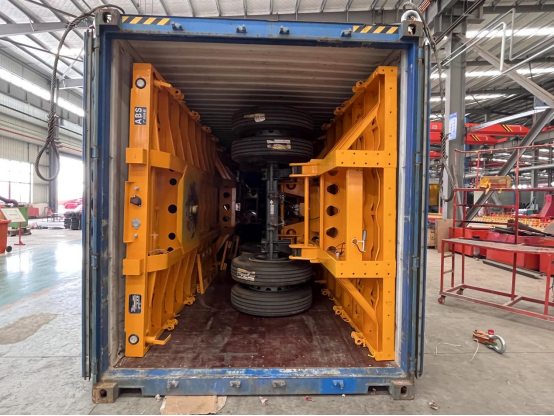
To optimize shipping costs for international clients, our container chassis are typically shipped in a stacked configuration. Three chassis can be bundled together, with the top two inverted and secured onto the bottom one. This bundle has the approximate dimensions of a 40ft High Cube container, allowing for cost-effective transport via container vessel. Alternatively, units can be shipped via Roll-on/Roll-off (RoRo) vessels. We offer flexible logistics terms, including FOB, CIF, and DDP, to streamline the procurement process for our global partners.
Quality Assurance, Compliance & International Standards
Every chassis we manufacture is subject to a rigorous quality control process aligned with ISO9001 standards. Our commitment to quality ensures reliability and compliance with international regulations. Key factory testing procedures include:
- Weld Inspection: Non-destructive testing (NDT) of critical welds to ensure structural integrity.
- Dimensional Accuracy Checks: Verification of all key dimensions, including kingpin placement and twist lock spacing, against engineering drawings.
- Load Testing Simulation: Finite Element Analysis (FEA) and physical stress tests to validate design capacity.
- Brake System Testing: Full functional test of the pneumatic braking system to ensure compliance and safety.
- Coating Adhesion & Thickness Test: Quality checks on the paint and protective coatings for durability.
Frequently Asked Questions (FAQ)
What is the typical lead time for a standard order of 20ft container chassis?
Lead time for standard configurations is typically 30-45 days. Custom orders may require an additional 15-20 days depending on the complexity of the engineering and component sourcing.
What axle and suspension brands do you offer?
We offer a range of globally recognized brands to meet various performance and budget requirements, including BPW, FUWA, and JOST. We can also integrate other brands upon client request.
How are the chassis protected against rust and corrosion?
Our standard process includes shot blasting the entire frame to SA2.5 standard, followed by a high-zinc epoxy primer and a durable polyurethane topcoat. For extreme environments, we offer hot-dip galvanization as an option.
Can you supply compatible Trailer Parts for long-term maintenance?
Yes, we maintain a comprehensive inventory of spare parts for all chassis we manufacture, including brake components, suspension parts, twist locks, and lighting, ensuring long-term serviceability for your fleet.
For detailed specifications or to discuss your specific fleet requirements, please submit your inquiry for a formal quote.
Heavy Duty Flatbed Axle Ratings & Export Market Trends
Sourcing a heavy duty flatbed for export? Understand key market trends, axle ratings, and compliance to make a strategic procurement decision. Get a q...
Read More →
A Buyer's Guide to the 20ft Container Chassis
Discover the essential guide to selecting a 20ft container chassis. Learn about types, key features, dimensions, and customization options. Request a ...
Read More →