




Reduce Drayage Delays With Container Chassis Trailers
In global logistics, efficiency at ports and intermodal terminals is paramount. Delays, demurrage fees, and operational bottlenecks directly impact supply chain costs and delivery timelines. A high-performance container chassis trailer is the foundational equipment engineered to mitigate these challenges, providing a reliable and versatile platform for moving shipping containers swiftly and safely. This guide explores the critical applications and technical specifications that make these skeletal trailers an indispensable asset for logistics operators, manufacturers, and fleet managers worldwide.
| Target Industry | Primary Material / Component | Key Benefit / Value Delivered |
|---|---|---|
| Port Logistics & Drayage | High-Strength Q345B Steel Frame | Faster container turnaround, reduced dwell time |
| Intermodal Transport (Rail/Road) | ISO-Standard Twist Locks | Secure, standardized container handling |
| Manufacturing Supply Chain | Air or Mechanical Suspension Systems | Reliable just-in-time component delivery |
Core Functional Capabilities
At its core, an intermodal container chassis is a purpose-built skeletal frame designed exclusively to carry and transport ISO shipping containers. Its function is straightforward but critical: to provide a secure, road-legal connection between a tractor unit and the containerized cargo. The primary mechanism involves robust twist locks, typically four to twelve per chassis, which engage with the container's corner castings to lock it firmly in place.
These trailers are engineered to handle a variety of container types and working environments, demonstrating significant operational flexibility. Key compatible loads include:
- Standard Dry Containers: 20ft, 40ft, and 45ft standard and high-cube (HC) containers.
- Refrigerated Containers (Reefers): Chassis can be configured to accommodate the weight and power needs of temperature-controlled units.
- Tank Containers: Specialized chassis designs provide the stability needed for transporting liquids and gases in 20ft or 30ft tank containers.
- Heavy-Duty & Special Loads: Configurations with additional axles or reinforced frames are available for overweight or specialized containers.
Industry-by-Industry Breakdown
The applications for these trailers span every sector that relies on containerized freight. Understanding their role within specific industries highlights their value in modern logistics.
Port & Intermodal Logistics
This is the primary application, focusing on drayage—the short-haul movement of containers from a port to a nearby rail yard, warehouse, or distribution center. In this high-volume environment, the main operational advantage is speed. A dedicated and well-maintained fleet of chassis allows operators to avoid "chassis pool" shortages, which are a common cause of port container transport delays. By controlling their own assets, companies can significantly improve truck turnaround times and minimize costly detention and demurrage fees.
Manufacturing & Just-in-Time (JIT) Supply Chains
Modern factories often rely on containers to deliver raw materials and components directly to their production facilities. A chassis can be used as a mobile-loading dock, allowing a container to be dropped in a yard and unloaded as needed. This "drop-and-hook" operation decouples the tractor and driver from the unloading process, maximizing driver productivity and ensuring a steady flow of materials without requiring extensive warehouse space. This system integrates perfectly with other transport solutions, like Flatbed Trailers for oversized components.
Agriculture & Bulk Commodities
The agricultural sector uses specialized containers, such as grain carriers or liquid tankers, to move bulk products from farms to processing plants or export terminals. A versatile chassis fleet, capable of handling both standard dry vans and specialized tank containers, provides the flexibility needed to manage seasonal demand. The robust construction of these chassis ensures safe transport over rural and sometimes challenging road conditions. For heavier bulk loads, a robust chassis is as crucial as a dedicated Bulk Cement Trailers is for construction materials.
Retail & Distribution
Large retailers and e-commerce giants depend on the uninterrupted flow of goods from ports to massive fulfillment centers. Owning or leasing a private chassis fleet gives these companies greater control over their supply chain, a key factor in container chassis fleet management. This control is vital for handling seasonal peaks (e.g., holiday shopping) and ensuring products reach distribution networks on schedule, ultimately preventing stockouts and lost sales.
Real-World B2B Case Study Scenario
- Problem: A mid-sized third-party logistics (3PL) provider in a major port city was consistently facing drayage delays and incurring over $15,000 per month in detention fees due to unreliable access to the port's shared chassis pool.
- Technical Challenge: Drivers were waiting an average of three hours for a road-worthy chassis, drastically reducing the number of container moves per shift and causing shipment backlogs.
- Solution Implemented: The 3PL invested in a private fleet of twenty 40ft gooseneck container chassis trailers. These versatile units could handle standard and high-cube containers and were stationed at the 3PL's yard, ready for immediate dispatch.
- Measurable ROI: Within three months, the company reduced driver wait times by 90% and eliminated nearly all detention fees. They increased their daily container throughput by 30% without adding more drivers, directly improving profitability and client satisfaction. This demonstrates how can chassis improve drayage operations significantly.
Application-Based Selection & Specification Matrix
Choosing the right chassis configuration is essential for safety, efficiency, and regulatory compliance. This matrix provides guidance for technical buyers.
| Application / Load | Recommended Chassis Type | Key Specifications |
|---|---|---|
| Standard 40ft Dry/HC Container | Gooseneck Tandem Axle | 12 twist locks, 13m length, air suspension, 2-axle configuration. |
| Single Heavy 20ft Container | Sliding Tandem Axle or Center-Mount | Adjustable axle position for weight distribution, reinforced frame. |
| Two 20ft Dry Containers (Twin Lift) | 40ft or 45ft Tandem/Tridem Axle | Multiple twist lock positions to secure both containers. |
| 20ft/30ft ISO Tank Container | Drop-Deck Frame Tridem Axle | Lower center of gravity, 3-axle for stability, specific for liquid transport similar to Specialized Liquid Tanker needs. |
Customization & OEM/ODM Capabilities
Standard chassis models meet most needs, but many applications require custom solutions. As a manufacturer, we offer extensive OEM/ODM capabilities to meet unique operational requirements. Customization options include:
- Corrosion Resistance: Hot-dip galvanization or specialized marine-grade paint for operations in coastal or high-humidity environments.
- Component Specification: Choice of axle, suspension, and braking systems from leading global brands (e.g., BPW, FUWA) to match existing fleet standards.
- Lighting and Electrical: LED lighting systems and wiring harnesses configured to meet specific regional regulations (e.g., ADR, DOT).
- Tire Selection: Options for highway, regional, or mixed-service tires based on expected road conditions.
- Fleet Branding: Custom paint colors and logo application for brand consistency across your entire fleet.
Export Packaging, Logistics & Global Shipping Guidance
We ensure every chassis arrives at its international destination in perfect condition. To optimize shipping costs, chassis are typically stacked and shipped in sets of 2, 3, or 4 within a single 40ft high-cube container. All units are securely braced and lashed to prevent movement and damage during transit.
We offer flexible shipping terms, including FOB (Free On Board), CIF (Cost, Insurance, and Freight), and DDP (Delivered Duty Paid), to accommodate your procurement process. Our logistics team manages all documentation to ensure compliance with international transport regulations for a smooth customs clearance process.
Quality Assurance, Compliance & International Standards
Our manufacturing process is certified under ISO 9001, ensuring consistent quality and adherence to strict production standards. Every chassis is built using high-strength steel (Q345B grade or higher) for maximum durability and lifespan. Before dispatch, each unit undergoes a rigorous quality control inspection, including:
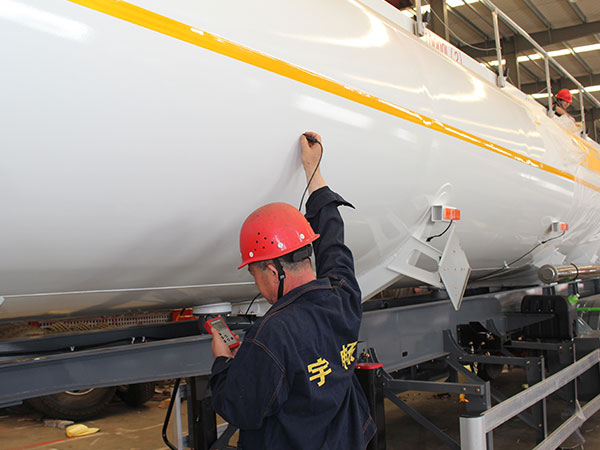
- Weld Integrity Testing: Non-destructive testing on critical welds to ensure structural soundness.
- Dimensional Verification: Checks to confirm all dimensions, including kingpin settings and twist lock positions, meet ISO standards.
- Brake and Light System Test: Full functional testing of the pneumatic and electrical systems.
- Load Simulation: Analysis to verify the chassis meets its rated payload capacity.
We ensure all components, from the axles down to the smallest Trailer Parts, meet international quality benchmarks.
Frequently Asked Questions (FAQ)
What is the typical operational lifespan of a container chassis trailer?
With proper maintenance and operating within its load limits, a well-built steel chassis can have an operational lifespan of 15 years or more. Factors like climate, road conditions, and maintenance frequency play a significant role.
What are the key maintenance requirements?
Routine maintenance is crucial for safety and longevity. This includes regular inspections of tires for pressure and wear, checking brake system performance, lubricating moving parts like slack adjusters, and ensuring all twist locks function correctly and are free of damage.
Can you accommodate different kingpin settings for various international markets?
Yes. We manufacture chassis with fixed or adjustable kingpin settings to match the fifth-wheel height and position of tractor units used in different regions, such as North America, Europe, and Australia.
What is the typical lead time for a custom fleet order?
Lead times vary based on the level of customization and order volume. A standard order is typically ready for shipment within 30-45 days, while highly customized designs may require 60 days or more. We provide a detailed production schedule upon order confirmation.
For detailed specifications or to discuss your specific fleet and application requirements, please submit your drawings for a technical review.

Choosing Compartments and Axles for a Fuel Tanker Trailer
Compare compartment layouts, axle configurations and specs for a fuel tanker trailer. Send your capacity and route details to request a quote.
Read More →
Container Chassis Trailer: Extendable vs Fixed Frame
Choosing between an extendable and fixed frame container chassis trailer? This guide compares specs, cost, and applications to help you decide. Reques...
Read More →