 WhatsApp
 sales@youcantrailer.com
 +8615203709888
How to Choose the Right Semi Trailer for Your Business in 2026
How to Choose the Right Semi Trailer for Your Business?
Quick Answer
The right semi trailer is the one that fits your cargo, route, loading method, legal limits, tractor compatibility, maintenance environment, and business model. Do not start only from a trailer name such as flatbed, lowbed, tanker, or dump trailer. Start from what the trailer must do every day. A logistics company moving containers needs different priorities from a contractor moving excavators or a cement company delivering powder. A good selection process compares payload, deck height, axle configuration, suspension, brake system, corrosion protection, and spare parts availability before the order is confirmed.
Engineering Note: In many export projects, the wrong trailer is not completely wrong on paper. It is usually wrong for the working condition. A specification that looks strong for highway use may create maintenance problems on rough rural roads, while an overbuilt trailer may reduce payload and increase operating cost.
What Does "Right Semi Trailer" Mean for a Business?
Choosing the right semi trailer means selecting a transport tool that can make money reliably in your real operation. It is not only a question of body type. It is a business decision that affects transport efficiency, repair cost, cargo safety, delivery schedule, driver workload, and resale value.
For example, a buyer may ask for a flatbed trailer because flatbeds are common and flexible. That may be correct for containers, steel, palletized cargo, or mixed freight. But if the main task is moving excavators, a lowbed trailer may be safer and easier to load. If the customer transports bulk cement, a bulk cement trailer is not optional; it is part of the unloading system. If the business serves fuel, water, or liquid cargo, the buyer must consider tank structure, discharge system, safety accessories, and local regulations.
The right trailer should answer three questions clearly: what cargo will it carry, where will it operate, and how will it be maintained after delivery? If any of these answers are unclear, the trailer specification is not ready.
Why Business Use Matters More Than Trailer Name
Many overseas buyers begin with a familiar product name. This is understandable, especially when local competitors use similar trailers. But trailer names can hide major engineering differences. Two flatbed trailers may both be 40ft, but one may be designed for port container work and another for mixed cargo on rough African or South American roads. Two lowbeds may both carry heavy equipment, but ramp angle, deck height, axle number, suspension type, and tire choice can change how safely the machine is loaded.
A trailer should be selected around the income-generating job. A fleet owner may need high uptime and easy local service. A distributor may need a configuration that fits many customers in the region. A government contractor may need durable equipment for infrastructure projects. A cement company may care more about unloading speed and pipeline reliability than general cargo flexibility.
Engineering Note: A trailer with the lowest purchase price can become expensive if it is not compatible with local tires, suspension parts, brake components, or repair skills. In export markets, serviceability is often as important as structural strength.
Decision Matrix: Match the Business Task to the Trailer Type
The following matrix is not a fixed rule, but it gives buyers a practical starting point. Final selection should still be confirmed with cargo details, road conditions, tractor data, and local requirements.
| Business Task | Common Trailer Choice | Suitable Application | Main Advantage | Buyer Consideration |
|---|---|---|---|---|
| Containers, steel, machinery, pallets, mixed cargo | Flatbed trailer | General logistics, container ports, regional freight | Flexible cargo range and simple structure | Confirm twist locks, floor thickness, lashing points, and axle load |
| Excavators, loaders, road machinery | Lowbed trailer | Construction, mining, infrastructure projects | Lower deck height and easier heavy equipment loading | Confirm machine weight, track width, ramp design, ground clearance, and road limit |
| Bulk cement, fly ash, powder cargo | Bulk cement tanker | Cement plants, ready-mix concrete, construction supply | Specialized pneumatic unloading | Confirm tank volume, compressor matching, pipeline layout, and discharge distance |
| Sand, gravel, coal, construction material | Dump or tipper trailer | Quarries, construction sites, mining support | Fast unloading and high site efficiency | Confirm material density, hydraulic system, body thickness, and rollover risk |
| Fuel, water, chemical or liquid cargo | Tank trailer | Distribution projects and industrial supply | Purpose-built cargo containment | Confirm cargo type, compartments, valves, safety fittings, and local regulations |
Start With the Cargo, Not the Trailer
The cargo determines the trailer more than any other factor. A buyer should record the cargo type, maximum weight, cargo dimensions, density, center of gravity, packaging method, loading points, and unloading method before asking for a quotation.
For container and mixed cargo, the buyer should consider whether twist locks, side stakes, front board, rope hooks, toolboxes, and spare tire carriers are needed. For construction equipment, machine track width, approach angle, bucket position, and loading ramp strength matter. For powder cargo, tank volume alone is not enough; buyers should also consider compressor matching, pipeline layout, air pressure control, and unloading site conditions.
One common issue we have seen is that buyers describe the cargo only by industry. "Construction material" can mean cement bags, steel bars, sand, blocks, or heavy machines. Each cargo creates a different trailer decision.
Confirm Road Conditions and Operating Area
A trailer used on highways can be configured differently from a trailer used on mining roads, rural roads, construction sites, or cross-border routes. Road condition affects frame reinforcement, suspension choice, tire specification, ground clearance, braking stability, and paint protection.
For long-distance highway transport, buyers often focus on payload efficiency, tire wear, fuel economy, and stable high-speed operation. For rough roads, mechanical suspension, stronger structural details, tire availability, and easier repair may become more important. For coastal or humid areas, corrosion protection and paint process deserve more attention.
Engineering Note: The road does not only affect the frame. It affects every repeated load cycle in the trailer. Bad roads increase vibration on the suspension, stress around welded joints, looseness in accessories, and fatigue around support points. A trailer for rough service should be reviewed as a system, not as isolated parts.
Check Payload, Axle Load and Legal Limits
Payload is not just the weight that the trailer can physically carry. It must be checked together with legal axle limits, tractor capacity, tire rating, brake system, cargo distribution, and local road regulations. If a buyer only asks for "60 tons" without explaining the route and legal environment, the factory cannot responsibly finalize the configuration.
In many markets, practical payload is affected by both engineering and enforcement. Some countries focus strongly on axle load, some on gross combination weight, and some on registration documents. Buyers should confirm local rules before production, because changing axle configuration or dimensions after manufacturing is expensive.
For export buyers, this is also a commercial issue. A trailer that cannot legally run at the intended payload may reduce the return on investment, even if the steel structure is strong enough.
Real Configuration Examples for Different Businesses
The following examples come from practical export-style configuration sheets. They are not universal recommendations. Their value is to show how different businesses require different engineering priorities. A buyer should use these examples to understand the selection logic, then confirm the final specification according to local regulations, tractor data, road conditions, and cargo details.
| Business Need | Example Trailer Configuration | Key Parameters | What Buyers Should Learn |
|---|---|---|---|
| Mixed cargo and container work | 40ft 3 axle flatbed semi trailer, model YCH9400TPB | 12,400 x 2,480 x 1,580 mm; 40,000 kg payload; FUWA 13T x 3 axles; 12R22.5 tires; 12 twist locks for 1 x 40ft, 2 x 20ft, or 1 x 20ft containers | A flatbed is useful when the business needs flexibility. Buyers should confirm floor plate, twist locks, lashing points, tire availability, and whether the cargo is truly suitable for an open platform. |
| Dedicated container transport | 40ft 3 axle skeleton semi trailer, model YCH9400TJZ | 12,400 x 2,480 x 1,620 mm; 6,200 kg tare weight; 50,000 kg payload; FUWA 13T x 3 axles; 295/80R22.5 tires; WABCO relay valve and WABCO ABS; 12 twist locks | A skeleton trailer is lighter and more focused than a flatbed for container work. It is not a general cargo platform, so buyers should choose it when container transport is the main revenue source. |
| Excavators and construction machinery | 3 axle 13.5m lowbed semi trailer, model YCH9403TDP | 13,500 x 3,000 x 3,400 mm; 9,500 mm working platform; 10,900 kg tare weight; 50,000 kg payload; main beam 16/12/18 mm, height 520 mm; FUWA 13T x 3 axles; 5 mm anti-skid floor | A lowbed should be selected around machine dimensions and loading method. Track width, ramp design, deck height, and ground clearance matter as much as payload. |
| Oversized or heavier equipment projects | 4 axle 16m lowbed semi trailer, model YCH9404TDP | 16,000 x 3,500 x 3,100 mm; 6,200 mm center deck effective length with exposed tires; 14,700 kg deadweight; 50,000 kg payload; 18/10/18 mm main beam; 4 x FUWA 13T axles; 1,000 mm spring-assisted mechanical ramps | More axles and a wider structure do not automatically mean a better trailer. They are useful only when the machine size, route permit, turning space, and loading site justify them. |
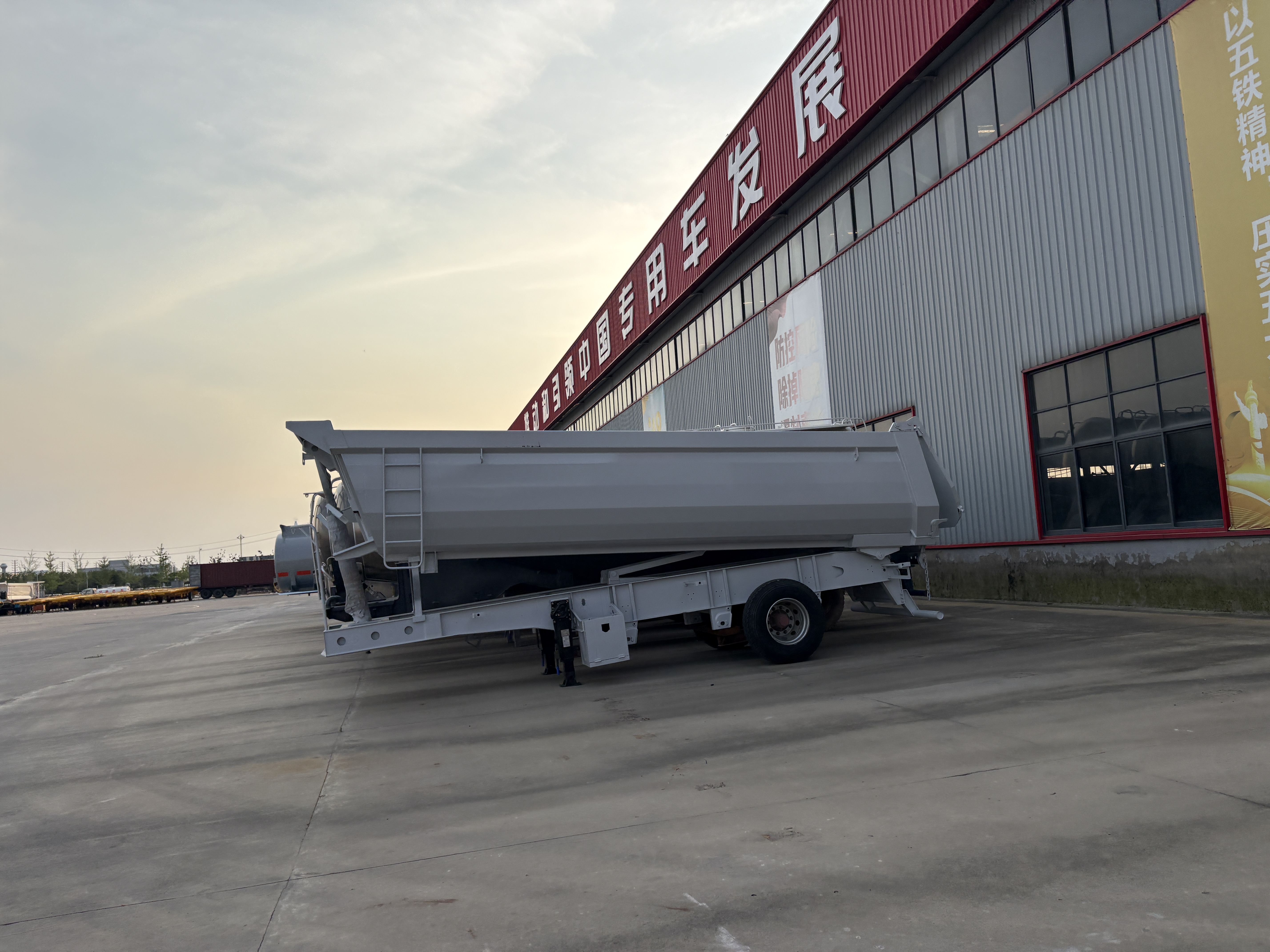
| Sand, gravel, aggregates, or site material | 3 axle 25CBM U-shape dump tipping trailer, model YCH9390ZZXT | 9,270 x 2,492 x 3,398 mm; 25 m3 capacity; 36,000 kg payload; 9,400 kg tare weight; 5 mm bottom and side plates; FUWA 13T x 3 axles; 3-axle reinforced mechanical suspension; hydraulic system 200-5-6800 | Dump trailer selection should consider material density, unloading area, hydraulic stability, body thickness, and rollover risk. Volume alone does not define the correct trailer. |
| Bulk cement and powder logistics | 3 axle 28 m3 bulk cement tanker, model YCH9402GXH | 9,750 x 2,550 x 3,720 mm; 28 m3 single compartment; 7,500 kg tare weight; 3 mm 610L tank body with laser cutting and robot welding; FUDA 12/2-S compressor; Huafeng 4102 diesel engine; BPW 12T x 3 axles; air suspension with front axle lift | A cement tanker is part of an unloading system. Buyers should review compressor, pipeline, discharge port, ash pipe, tank volume, and site unloading distance, not only tank capacity. |
| Higher-volume dry bulk powder transport | 3 axle 34 m3 dry bulk trailer, model YCH9408GFLC8 | 10,750 x 2,550 x 4,000 mm; 34 m3 effective volume; 8,690 kg tare weight; 3 mm 620JJ tank body; 5 mm oval end plate; 2 cones; FUDA 12/2-S compressor; Huafeng 4102 diesel engine; reinforced mechanical suspension | Higher volume can improve trip efficiency, but it must match cargo density, road height restrictions, unloading system, and tractor capability. |
| Fuel distribution and liquid transport | 3 axle 46,000L aluminum fuel tanker, model YCH9400GYL | 12,650 x 2,550 x 3,630 mm; 46,000L capacity; 6 compartments; 7,500 kg tare weight; 5182 aluminum tank body; FUWA 13T x 3 axles; air suspension with front axle lift; API valves; hydrostatic test to 5 psi on each compartment | Fuel tanker selection is driven by cargo safety, compartment layout, valve system, loading and discharging method, testing, and local regulatory expectations. |
These examples show why a buyer should not ask a factory for a "good trailer" without explaining the business. A 50,000 kg payload appears in both skeleton and lowbed examples, but the engineering purpose is different. One is built around container locking and lower tare weight. The other is built around heavy equipment loading, platform geometry, ramps, and structural support. The same number does not mean the same trailer.
How YOUCAN Reviews a Buyer's Trailer Requirement
At YOUCAN Trailer, a trailer selection discussion normally begins with working conditions rather than a fixed product list. The buyer may already have a preferred trailer type, but the engineering conversation should still confirm the cargo, route, payload, loading method, tractor model, road condition, climate, local regulations, and maintenance environment.
This process helps reduce mistakes before the quotation stage. If a buyer asks for a flatbed trailer, the team should still clarify whether the trailer will carry containers, palletized cargo, steel, construction material, or general mixed cargo. If the buyer asks for a lowbed, the machine model, track width, operating weight, and ramp requirement should be reviewed. If the buyer asks for a tanker, cargo type and unloading method become central.
Step 1: Define the Job
The first step is to define the job in practical language. Instead of saying "I need a heavy-duty trailer," a buyer should explain what cargo is carried, how often it is loaded, what roads it uses, and what problems the current fleet experiences.
Step 2: Translate the Job Into Engineering Requirements
The second step is to translate the business job into engineering requirements. Cargo weight affects axle configuration. Road quality affects suspension and reinforcement. Loading method affects deck structure, ramp design, floor thickness, and accessories. Climate affects paint and corrosion protection.
Step 3: Confirm the Specification Before Production
The third step is specification confirmation. Drawings, bill of materials, major component brands, paint color, accessories, shipping method, and inspection items should be checked before production starts. This is especially important for custom semi trailers, because small changes can affect cost, lead time, and component compatibility.
Engineering Note: A clear specification is not only for the factory. It protects the buyer. When the quotation, drawing, bill of materials, and inspection checklist all describe the same trailer, the chance of dispute is much lower.
Choose by Industry Application
Different industries usually need different trailer priorities. The following examples show how business use changes the selection logic.
Logistics and Container Transport
Logistics companies often need flexible trailers that can carry containers, pallets, steel, machinery, or mixed cargo. A flatbed trailer is often suitable when the fleet needs broad cargo flexibility. Buyers should confirm twist locks, lashing points, floor plate, side protection, tire specification, and loading height.
Construction and Heavy Equipment
Construction companies usually care about safe loading, machine stability, ground clearance, and durability. For excavators, bulldozers, loaders, and road machinery, lowbed trailers are often a better fit than ordinary flatbeds. The buyer should provide machine weight, dimensions, track width, and loading site condition before choosing the final lowbed design.
Cement and Powder Transport
Cement companies should not choose a trailer only by tank volume. A cement tanker must work together with the compressor, pipeline, discharge valve, air system, and unloading site. For a cement business, unloading efficiency and cleaning convenience may affect daily profit more than small differences in purchase price.
Mining, Aggregates and Rough-Site Transport
Mining and aggregate businesses usually require stronger structures, durable suspension, reliable hydraulic systems for dump trailers, and components that can be serviced locally. Buyers should be careful about overweight expectations, because high-density material can overload the trailer quickly.
Government and Infrastructure Projects
Government contractors may need repeatable specifications, inspection documents, and stable delivery schedules. In these projects, selecting the trailer is not only an engineering decision. It also affects tender documents, maintenance planning, operator training, and spare parts management.
Compare Standard Configuration and Custom Configuration
A standard configuration is suitable when the buyer's operation is close to common market use. It usually gives faster delivery, easier cost control, and proven design. A custom configuration is suitable when the cargo, route, loading method, regulations, or branding requirements are different from standard use.
| Choice | Best For | Advantages | Limitations | Buyer Considerations |
|---|---|---|---|---|
| Standard configuration | Common cargo and mature local market use | Faster quotation, shorter lead time, proven design | May not solve special loading or route problems | Check whether the standard design truly matches your road and cargo |
| Modified standard configuration | Buyers needing small changes to a proven base model | Balanced cost, speed, and suitability | Changes must be controlled to avoid conflict between components | Confirm which items are changed and which remain standard |
| Custom configuration | Special cargo, special route, fleet standardization, or project tender | Better fit for real operation and buyer requirements | Longer confirmation time and possible higher cost | Provide complete working conditions and approve drawings before production |
Common Buyer Mistakes
Choosing a trailer is easier when buyers know the common mistakes in advance. These mistakes are not rare. They appear often in international purchasing because buyers, factories, agents, and final users may all describe the same project differently.
Mistake 1: Choosing by Price Before Defining the Job
If two quotations describe different axle brands, floor thickness, suspension types, tire quantities, painting systems, or accessories, the lower price may not be the better offer. A fair comparison starts with the same specification.
Mistake 2: Ignoring Tractor Compatibility
The trailer must match the tractor's fifth wheel height, king pin requirement, brake connection, electrical system, and pulling capacity. If the buyer does not provide tractor information, the trailer may require adjustment after arrival.
Mistake 3: Overlooking Local Spare Parts
Many buyers compare component brands but forget local parts supply. If a premium component is difficult to repair locally, downtime may increase. In some markets, a practical, common component can be a better business decision than a more expensive but less available option.
Mistake 4: Treating Payload as the Only Strength Indicator
Payload is important, but the trailer also needs correct load distribution, frame design, suspension matching, tires, braking, and driving behavior. A stronger beam does not automatically solve every working condition.
Mistake 5: Confirming Paint Color but Not Paint Process
Color affects appearance, but surface preparation and paint system affect durability. For humid, coastal, dusty, or construction-site use, buyers should ask how the surface is prepared and which paint system is applied.
Industry Standards and Best Practices
Industry standards should be used as a common language for quality, safety, and process control. Buyers should avoid asking for vague compliance claims. A better approach is to ask which standard or regulation affects the trailer and what evidence can be checked before shipment.
UNECE vehicle regulations are important references for many markets when discussing vehicle safety and regulatory expectations. ISO 9001 is useful when discussing quality management systems, but it should not replace product inspection. ISO 3834 is relevant when discussing welding quality requirements, and ISO 12944 is useful when discussing corrosion protection through paint systems. These references help buyers ask better questions, but they should not be used to invent certifications that were not actually provided.
Engineering Note: Standards help define the inspection language. They do not replace project-specific engineering. A buyer still needs cargo data, route data, drawings, and inspection records for the actual trailer being ordered.
Buyer Checklist Before Confirming a Semi Trailer
Before confirming the order, buyers can use the following checklist to avoid unclear requirements.
Confirm cargo type, maximum weight, dimensions, density, and loading method.
Confirm route, road condition, climate, and operating area.
Confirm legal limits, axle load rules, and registration requirements in the destination country.
Confirm tractor model, fifth wheel height, king pin requirement, air brake connection, and electrical voltage.
Confirm axle brand, tire size, suspension type, brake system, landing gear, and spare tire requirement.
Confirm whether standard, modified standard, or custom configuration is required.
Confirm drawings, bill of materials, paint color, accessories, and inspection checklist before production.
Confirm shipping method, delivery time, packing plan, and required export documents.
Questions to Ask the Manufacturer
A reliable manufacturer should be able to explain why a configuration is recommended. Buyers can ask the following questions before placing an order:
Why do you recommend this trailer type for my cargo and route?
Which parts of the specification are standard and which are customized?
How does the axle and suspension configuration match my payload?
Can you provide drawings or a configuration sheet before production?
What photos or inspection records will be available before shipment?
Which components are easy to maintain in my market?
How will the trailer be prepared for ocean shipping?
Why YOUCAN Trailer?
YOUCAN Trailer, Henan Yuchang Vehicle Manufacturing Co., Ltd., was established in 1999 and has long experience in manufacturing and exporting semi trailers for different working conditions. For buyers, the practical value is not only that YOUCAN can produce trailers. The value is that the project can be discussed from cargo, route, structure, component matching, inspection, and delivery together.
For export buyers in Africa, the Middle East, Central Asia, South America, and Southeast Asia, trailer selection often requires more than a catalogue. Local road conditions, parts availability, climate, loading habits, and shipping method all matter. YOUCAN's role is to help buyers translate those working conditions into a clear configuration before production starts.
Key Takeaways
Choose a semi trailer based on business use, not only product name.
Cargo, route, loading method, legal limits, and maintenance environment should be confirmed before quotation.
A 40ft flatbed can be flexible for mixed cargo and containers, but it is not the best answer for every business.
Lowbed trailers, cement tankers, dump trailers, and tank trailers solve different transport problems.
Compare quotations only after the key specification is the same.
Local spare parts availability can be as important as component brand.
Drawings, bill of materials, and inspection checklists should be confirmed before production.
Standards and regulations should guide questions, not replace project-specific engineering review.
Conclusion
The right semi trailer for your business is the trailer that fits your work every day. It should carry the right cargo, match the route, comply with local requirements, connect correctly with the tractor, and remain serviceable in your market. For international buyers, the safest purchasing process is to define the business task first and then convert that task into a controlled trailer specification.
If you are comparing trailer types or preparing a purchase specification, YOUCAN Trailer can help review your cargo, route, payload, and operating conditions before production. A clear discussion at the beginning is usually much cheaper than correcting the wrong trailer after delivery.
FAQ
What is the most versatile semi trailer for general business use?
A flatbed trailer is often the most versatile choice for general cargo, containers, steel, pallets, and some machinery. However, it is not ideal for every business. Heavy equipment, powder cargo, liquids, and bulk materials usually require more specialized trailers.
How do I know if I need a flatbed or a lowbed trailer?
Choose a flatbed when cargo can be safely loaded on a higher open platform. Choose a lowbed when the cargo is heavy equipment, tall machinery, or construction machines that need lower loading height and better stability.
Should I choose mechanical suspension or air suspension?
Mechanical suspension is often preferred for rough roads, heavy-duty work, and easier local maintenance. Air suspension may be better for cargo protection and smoother highway transport. The choice should match road condition, cargo sensitivity, and repair capability.
What information should I give a trailer manufacturer before asking for a quotation?
Provide cargo type, maximum weight, cargo dimensions, road condition, loading method, tractor information, destination country, preferred components, and any special requirements. The more complete the information, the more accurate the quotation.
Is a higher payload trailer always better?
No. A higher payload trailer may be heavier, more expensive, or unsuitable for local legal limits. Buyers should compare payload with axle limits, road regulations, tractor capacity, tire rating, and real business needs.
Can one trailer handle all transport jobs?
One trailer can handle many jobs if the cargo range is similar, but no trailer is best for all applications. Mixed cargo may fit a flatbed, while excavators, cement powder, fuel, and aggregates need different designs.
How can I reduce the risk of buying the wrong trailer?
Define the cargo and route first, request a written specification, confirm drawings and major components, check local spare parts availability, and ask for pre-shipment inspection photos or records before delivery.