 WhatsApp
 sales@youcantrailer.com
 +8615203709888
How Do Different Steel Grades Affect Trailer Performance?
How Do Different Steel Grades Affect Trailer Performance?
Quick Answer
Different steel grades affect trailer performance through strength, stiffness options, fatigue margin, weight, weldability, cost, repair practice, and availability. Q235, Q355, and higher-strength materials such as 700L may suit different locations and applications. The best selection is not the strongest grade everywhere. It is the grade and thickness that give the required performance after the complete frame, welds, supports, and operating loads are considered.
Steel Grade Is Only One Part of Performance
A trailer's performance is the result of material properties plus geometry and load path. Two frames can use the same grade and perform differently because their section depth, cross-member spacing, joint details, restraint, and load distribution are different. Buyers should therefore compare a complete design basis rather than a material label alone.
| Material option | Potential use | Main caution |
|---|---|---|
| Q235 structural steel | Secondary members, brackets, and designs where basic strength is adequate | Higher mass may be needed for the same structural target |
| Q355 structural steel | Primary members and weight-sensitive structures | Requires compatible welding and design discipline |
| 700L or similar high-strength material | Selected high-strength applications where the design supports it | Higher strength does not remove fatigue, buckling, or repair concerns |
| Mixed-grade design | Different materials used according to component function | Material identity and welding transitions need control |
How the Grade Changes Trailer Behavior
Strength and Section Efficiency
A higher-strength grade can allow the designer to review thickness or section geometry, but the result must still satisfy stiffness, buckling, fatigue, and connection requirements. The trailer should not be made thinner simply because the grade number is higher.
Tare Weight and Payload Efficiency
Reducing structural mass can be commercially valuable when legal weight limits restrict payload. But a lower tare weight may also reduce impact tolerance, wear margin, or repair simplicity if the design is pushed too far. The buyer should compare the whole operating cost rather than celebrate a single weight figure.
Weldability and Fabrication
Different grades and thicknesses can change preheat, heat input, procedure qualification, distortion, and repair considerations. The factory must know which material is being welded and must prevent grade mix-ups.
Fatigue and Local Stress
Trailer structures experience repeated loads. Weld toes, abrupt section changes, holes, brackets, and support transitions may govern fatigue before the nominal steel strength does. Detail design and fabrication quality remain critical.
Decision Matrix for Buyers
| Operating priority | Likely material direction | Why | Buyer check |
|---|---|---|---|
| Cost-sensitive standard trailer | Balanced use of common structural grades | Avoids paying for strength the design does not use | Is the grade matched to each component? |
| Payload-sensitive flatbed | Q355 or selected higher-strength design | May improve structural efficiency | What is the verified tare-weight and fatigue basis? |
| Rough-road heavy duty | Strength plus robust geometry and repairability | Impact and repeated loads matter together | How are sections, welds, and repairs designed? |
| Custom high-load structure | Engineering-led mixed-grade selection | Different zones have different demands | Is there a drawing and material schedule? |
Engineering Note: A steel grade should be traceable to a component and a design reason. If the only explanation is stronger is better, the engineering discussion is incomplete.
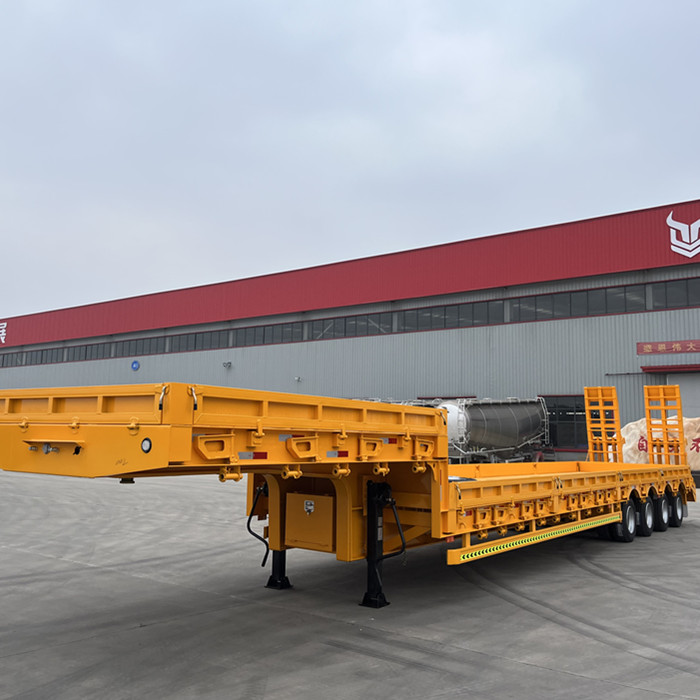
The material decision should follow the application of the flatbed trailers, lowbed trailers, or other body. Use quality control information to ask how material grades are identified, stored, cut, and recorded.
Common Buyer Mistakes
Comparing grade names without comparing structure, thickness, and tare weight.
Believing a higher yield strength automatically improves fatigue life.
Ignoring repair welding and service conditions in the destination market.
Requesting a high-strength grade everywhere without a component-by-component reason.
Treating a material certificate as proof that the finished frame is correctly designed.
Key Takeaways
Steel grade affects strength, weight, fabrication, cost, and repair options together.
Geometry and welded details often control real trailer performance.
Q235, Q355, and 700L may all be appropriate in different locations.
Higher-strength material still needs compatible welding and fatigue control.
Compare the complete design basis, not only the grade label.
FAQ
What is the difference between Q235 and Q355 in trailer use?
Q355 offers a higher nominal strength level and may support a more efficient design, while Q235 can remain suitable for parts where the design demand is lower.
What does 700L mean in trailer discussions?
It generally refers to a higher-strength material option used selectively in some designs. The exact standard, grade, thickness, and application must be defined in the specification.
Can high-strength steel make a trailer too light?
Yes, if weight reduction is pursued without enough stiffness, fatigue, impact, corrosion, or repair margin.
Which grade is best for a lowbed trailer?
The answer depends on load, deck geometry, route, machinery support points, and the complete frame design.
How should I compare two steel-grade quotations?
Compare the material schedule, thickness, beam geometry, tare weight, welding basis, inspection, and warranty assumptions.
Conclusion
Steel grade influences trailer performance, but it works through the design around it. Buyers should ask what problem the selected grade solves and whether the factory can control that grade from material receipt through welding and inspection.
References
GB/T 700 carbon structural steels
GB/T 1591 high strength low alloy structural steels
ISO 3834 quality requirements for fusion welding of metallic materials