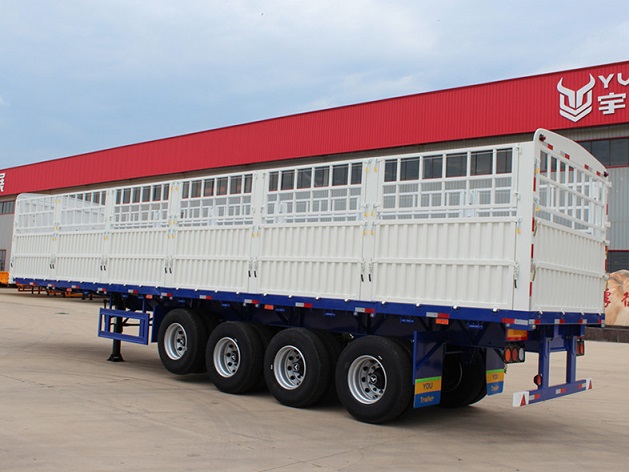
In the global logistics and freight industry, securing cargo properly is not just a matter of operational efficiency—it is a matter of life and death on the highway. Whether you are hauling steel coils, heavy machinery, or standard shipping containers, the method you use to secure the load is critical. This is especially true when operating a Flatbed Container Trailer. Because these trailers lack the enclosed walls of a dry van, the cargo relies entirely on the driver's rigging skills and the trailer's built-in securing mechanisms. Understanding exactly how to tie down a load on a flatbed trailer is a mandatory skill for every heavy-duty driver and fleet operator.
What is a Flatbed Container Trailer?
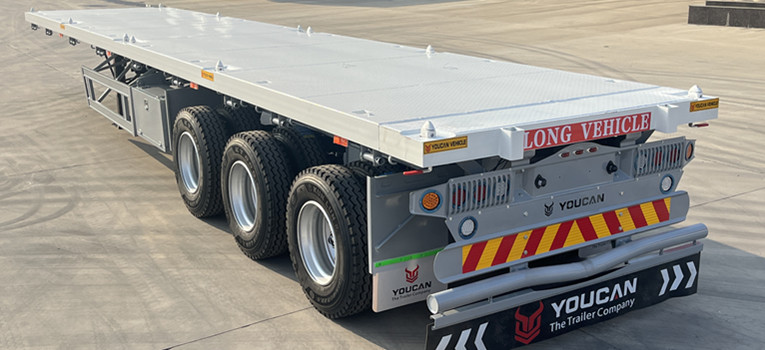
To understand how to secure a load, we first need to define the equipment. A Flatbed Container Trailer is a highly versatile transport vehicle characterized by a flat, level deck with no roof and no sides.
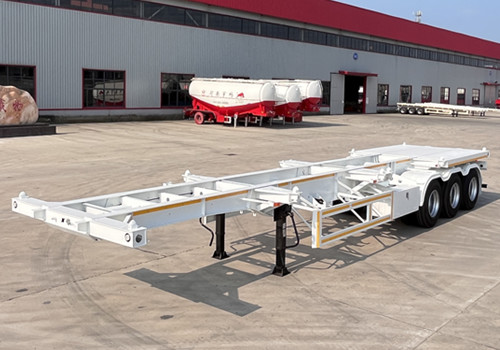
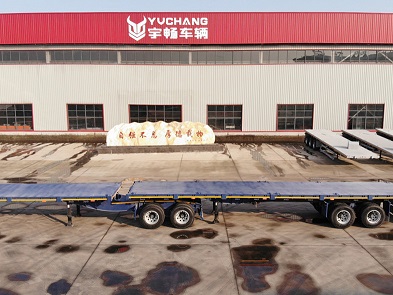
Structurally, the most common types of these flatbed trailers feature two heavy-duty main beams (longitudinal beams) that are spaced apart. These main beams are firmly connected using cross sills or multiple transverse beams, forming a rigid and robust platform. The vehicle-mounted part of the flatbed semi-trailer has no railings, which makes it incredibly adaptable. While it is widely used for medium and long-distance general cargo transportation, it is also heavily utilized in port environments to transport standard shipping containers. Because it is an open-deck platform, a Flatbed Container Trailer allows for top-loading and side-loading via cranes or forklifts, making it the most flexible asset in a modern fleet.
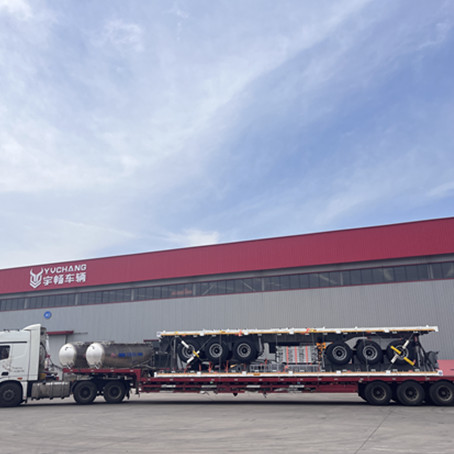
How Does a Flatbed Semi-Trailer Secure Cargo?
The core of this article is understanding the mechanics of securing a load, particularly when transporting containers. When using a flatbed semi-trailer to transport containers, how do you ensure the goods are firmly tied to the trailer? The process relies on a combination of mechanical locks and heavy-duty lashing. Step 1: Positioning the Container
First, a forklift or crane is used to lift the container and place it on the loading surface of the Flatbed Container Trailer. Depending on the length of the cargo bed, the trailer will be equipped with a specific number of container locks (twist locks). Generally, there will be between 8 to 12 twist locks installed along the sides of the deck.
Step 2: Engaging the Twist Locks
When the container is hoisted onto the load-bearing surface, the corner castings at the bottom of the container must align perfectly with the positions of the twist locks. The driver turns the handle of the twist lock, and the lock head rotates to a specified angle (usually 90 degrees or 70 degrees) to lock it securely inside the corner casting. For lifting-type twist locks, the handle is pushed longitudinally to lift the lock head, extending it into the inner cavity of the container's bottom corner, before rotating to lock it. Some advanced twist locks are equipped with a fastening device; by tightening it, the lock head is pressed firmly against the bottom surface of the corner fitting. This prevents the container corner from lifting and makes the locking mechanism much safer and more reliable.
Step 3: Secondary Lashing and Tie Down
While twist locks are the primary securing method for containers, using additional lashing straps is a vital safety protocol. On a Flatbed Container Trailer, there will be a corresponding number of rope tensioners (often ratchet binders or chain tensioners) located along the side rails. To use a wire rope tensioner, a steel wire of appropriate thickness and length is inserted into the designated hole in the take-up wheel. The wire is wrapped around the drum twice, and the other end is tied to a fixed point on the trailer. The wire is then straightened, and the handle is moved to tighten the wire rope, eliminating any slack. Once the destination is reached, the driver reverses the operation—untying the ropes and releasing the twist locks—to allow a forklift to safely unload the container.
The Advantages of Using a Flatbed Container Trailer
Why are these trailers so dominant in global logistics? The advantages of utilizing a Flatbed Container Trailer are substantial:
Ultimate Loading Flexibility: The absence of a roof and sidewalls means cranes and forklifts can load cargo from any direction. This is essential for oversized equipment that cannot be loaded through rear doors.
Container Intermodality: With the installation of twist locks, a Flatbed Container Trailer seamlessly transitions between hauling general freight and moving standard 20ft or 40ft ISO shipping containers.
Maximum Payload Capacity: Without the heavy steel or aluminum of an enclosed box, these trailers are lighter, allowing for a higher legal payload capacity.
Cost-Effective and Low Maintenance: The simple structural design of longitudinal beams and cross sills means fewer moving parts and less maintenance. The open deck is also easier to inspect for rust or damage compared to the internal walls of a closed van.
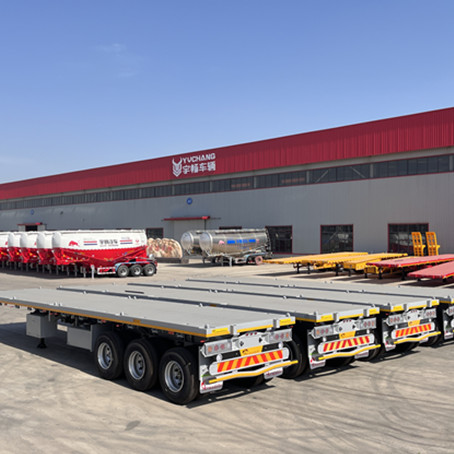
Applications of a Flatbed Container Trailer
The versatility of these trailers means they are used across a broad spectrum of industries:
Port Logistics: Moving containers directly from the docks to rail yards or distribution centers.
Construction: Hauling steel beams, lumber, concrete panels, and heavy machinery.
Manufacturing: Transporting oversized industrial components that require crane loading.
Agriculture: Moving large tractors, hay bales, and farming equipment.
Specifications of a Flatbed Container Trailer
When selecting a Flatbed Container Trailer for your fleet, you need to consider the payload, dimensions, and locking mechanisms. Standard specifications for our heavy-duty models include:
Standard Lengths: Typically 20ft, 40ft, or 45ft to accommodate standard container sizes.
Deck Width: Usually around 2,500mm (8.2 feet) to 3,000mm.
Twist Locks: Standard 8 to 12 units, recessed into the deck or mounted on the side rails, to secure 20ft, 40ft, or dual 20ft containers.
Main Beams: Constructed from high-strength steel (like Q345B) to withstand heavy concentrated loads.
Flooring: Heavy-duty checkered steel plate or wooden boards, designed to provide traction and withstand forklift movements.
Lashing Rings: Built-in D-rings or rope hooks along the entire length of the trailer for additional cargo tie-down.
Your Trusted Supplier for Flatbed Container Trailers
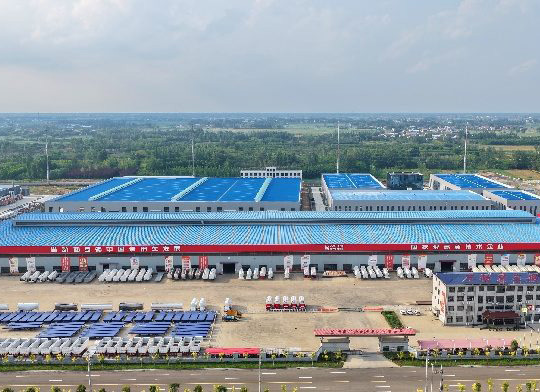
Securing a load safely starts with buying a trailer built to the highest standards. As a professional manufacturer, YOUCAN Trailer has over 28 years of experience in producing heavy-duty semi-trailers for global markets. Our 3 axle 40 ft flatbed semi trailer is designed with precision. We use automated welding lines to ensure that the cross sills and longitudinal beams are fused perfectly, providing unmatched structural integrity. Our trailers are equipped with heavy-duty, precision-cast twist locks that guarantee your containers won't shift during transit. Furthermore, we offer fully customizable solutions—you can choose the exact number of twist locks, the suspension type, and even the color of the polyurethane coating. With fast lead times, RoRo or container shipping options, and reliable after-sales support, YOUCAN is your ideal partner for fleet expansion.
Conclusion
Tying down a load on a Flatbed Container Trailer requires a combination of the right equipment, structural knowledge, and driver skill. By utilizing the built-in twist locks to lock the container corners and using wire rope tensioners for secondary lashing, you ensure that your cargo arrives safely and securely. Whether you are navigating busy port terminals or long-haul highways, safety should always be the priority. Ready to add a reliable, high-strength flatbed to your fleet? Contact our team today to get a quote and discuss your specifications.
FAQs
How many twist locks are needed for a flatbed container trailer?
The number depends on the trailer's length, but generally, a 40ft flatbed will be equipped with 8 to 12 twist locks to secure standard containers safely.
Can I transport non-container cargo on a Flatbed Container Trailer?
Absolutely. When the twist locks are recessed or removed, the flat deck is perfect for hauling steel, lumber, or heavy machinery.
What is the purpose of the rope tensioners on the trailer's sides?
Rope tensioners (ratchet binders) are used to tension wire ropes or lashing straps, providing a secondary securing method to prevent loads from shifting.
How do you ensure the twist locks are compatible with our containers?
Standard twist locks are designed to fit the universal corner castings of all ISO shipping containers. We ensure our locks meet international standards.
Do you offer customized sizes for flatbed trailers?
Yes. YOUCAN Trailer provides OEM and custom manufacturing. You can specify the exact length, width, and number of twist locks based on your operational needs.