




What Is a Flour Tanker Trailer?
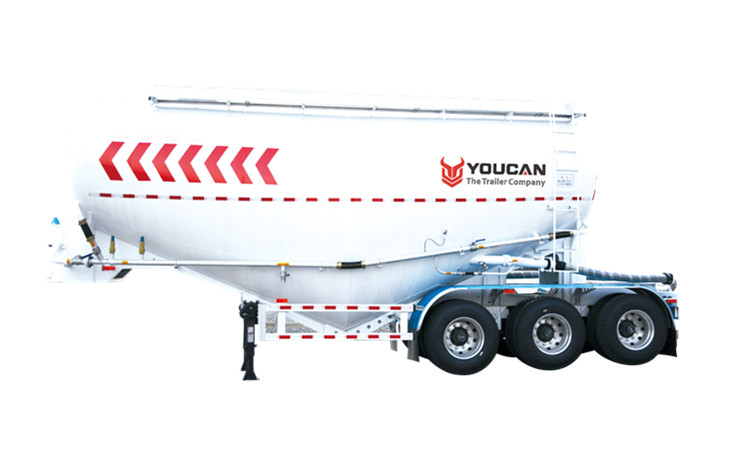
A flour tanker trailer is a specialized bulk transport vehicle designed to carry dry flour from milling facilities to bakeries, food processing plants, and other industrial customers. Instead of transporting flour in individual bags, it uses an enclosed tank to deliver large quantities of powdered material to compatible receiving silos.
Also known as a bulk flour tanker or flour transport trailer, this equipment generally uses a pneumatic conveying system to unload flour through a pipeline. Its tank structure, air supply, discharge equipment, and cleaning arrangements must be suitable for food-related operations.
Bulk flour transportation offers several advantages over bagged deliveries. It can reduce packaging requirements, minimize manual handling, and improve delivery efficiency for facilities that regularly receive large quantities of flour.
However, transporting flour requires more than an ordinary powder tanker. Because flour is a food ingredient, the equipment must be designed and maintained to prevent contamination. Materials in contact with the flour, cleaning accessibility, moisture control, and the quality of conveying air are especially important.
Companies evaluating bulk powder transport equipment can explore YOUCAN's bulk cement trailers to understand related pneumatic tanker designs. However, cement tankers are not automatically suitable for flour transportation. Food-contact materials, hygienic construction, cleaning procedures, and cargo compatibility must be confirmed separately.

Main Components and Working Principle of Flour Tanker Trailers
A flour tanker trailer combines a sealed storage tank, a supporting chassis, and a pneumatic unloading system. The components must work together to transport flour efficiently while maintaining appropriate hygiene standards.
Tank Body and Internal Structure
The tank body stores flour during transportation and protects it from direct exposure to rain, dust, and other external contaminants.
Its design may include a horizontal tank with internal discharge compartments or a configuration using sloping conical sections to guide material toward the outlets.
The choice of tank geometry influences material movement, cleaning access, residual product, and overall trailer dimensions.
For food applications, the surfaces that contact flour must be made from materials suitable for the intended food-contact use. Stainless steel is commonly considered for food-contact components, although the appropriate construction depends on the applicable regulations and approved design.
Air Compressor and Pneumatic System
Many flour tanker trailers use compressed air to transfer flour from the tank into a receiving silo.
The pneumatic system may include an air compressor, filters, air distribution lines, valves, fluidization components, and discharge piping.
Air quality is particularly important. Any air that contacts flour must be suitable for the food-handling process and controlled against contamination from oil, moisture, particles, and microorganisms as required by the operating system.
Compressor type, filtration, and maintenance procedures should therefore be reviewed as part of the complete hygienic design.
Chassis, Axles, and Suspension
The chassis supports the tank and transfers its load to the tractor and trailer axles.
The axle configuration and suspension system must match the trailer's intended operating weight, road conditions, and local regulations.
Other essential components include the kingpin, landing gear, braking system, tires, and electrical connections.
How Does a Flour Tanker Trailer Work?
The operating process generally involves three stages.
1. Loading: Flour is transferred from a mill or storage facility into the tank through a designated filling connection. The loading system should prevent moisture entry and minimize contamination.
2. Transportation: The loaded trailer travels to the receiving facility with all openings and fittings properly secured. The operator must ensure that the load remains within the trailer's rated capacity and legal vehicle weight limits.
3. Pneumatic unloading: At the destination, the discharge pipeline is connected to a compatible receiving silo. The pneumatic system moves flour from the tank through the pipeline into storage.
Unloading performance depends on flour characteristics, tank geometry, conveying air, pipe length, bends, and receiving-system conditions.
Operators must follow the equipment manufacturer's approved procedures and pressure limits. Flour dust can form a combustible atmosphere under certain conditions, making dust control, ignition-source prevention, and appropriate equipment selection essential.
Flour Tanker Trailer Specifications, Capacity, and Dimensions
Choosing the correct flour tanker trailer requires a clear understanding of tank volume, cargo weight, overall vehicle dimensions, and unloading requirements.
These specifications should be evaluated together rather than independently.
Flour Tanker Trailer Capacity
Tank capacity is usually expressed in cubic meters (m³), while payload is expressed in kilograms or metric tons.
These measurements are related but not interchangeable.
The estimated cargo weight can be calculated using:
Cargo Weight (tonnes) = Flour Volume (m³) × Bulk Density (tonnes/m³)
For example, assuming a flour bulk density of 0.60 tonnes/m³, a volume of 40 m³ would contain approximately:
40 × 0.60 = 24 tonnes of flour
This is a theoretical calculation. It does not confirm that a particular trailer can legally or safely carry 24 tonnes.
Actual flour bulk density varies with flour type, moisture content, particle characteristics, aeration, and handling conditions. The usable filling volume may also be lower than the nominal tank capacity.
Example Flour Tanker Capacity Calculations
The following examples illustrate how tank volume affects estimated cargo weight when an assumed flour bulk density of 0.60 tonnes/m³ is used.
| Material Volume | Assumed Bulk Density | Estimated Flour Weight |
|---|---|---|
| 30 m³ | 0.60 t/m³ | 18 tonnes |
| 35 m³ | 0.60 t/m³ | 21 tonnes |
| 40 m³ | 0.60 t/m³ | 24 tonnes |
| 45 m³ | 0.60 t/m³ | 27 tonnes |
| 50 m³ | 0.60 t/m³ | 30 tonnes |
Note: These figures are illustrative calculations, not verified specifications or approved payload ratings for YOUCAN flour tanker trailers. Actual loading limits depend on the cargo, vehicle design, and applicable regulations.
Flour Tanker Trailer Dimensions
Overall dimensions affect road access, maneuverability, loading compatibility, and the ability to operate at customer facilities.
Buyers should confirm the following measurements:
| Specification | What Buyers Should Check |
|---|---|
| Tank volume | Nominal and usable capacity in m³ |
| Overall length | Compatibility with routes and loading areas |
| Overall width | Local road and vehicle width restrictions |
| Overall height | Bridges, loading stations, and overhead clearances |
| Trailer tare weight | Empty weight of the approved configuration |
| Rated payload | Manufacturer's structural and operating limits |
| Axle configuration | Legal axle loads and weight distribution |
| Discharge connection | Compatibility with the receiving silo |
| Working pressure | Manufacturer-approved pneumatic system rating |
| Tank material | Suitability for food contact and cleaning |
There is no single standard set of dimensions suitable for every flour tanker trailer.
A higher-capacity tank may require a longer or taller structure, but the final design must still comply with the destination country's vehicle dimension and weight regulations.
Why Tank Volume Alone Is Not Enough
A trailer with a larger tank does not necessarily deliver more flour per trip.
For example, a larger tank may have a higher empty weight, or its permitted payload may be limited by the tractor, axle configuration, or local road rules.
The correct selection is based on usable volume, actual flour density, legal payload, and delivery requirements.
For additional background on volume and payload calculations, see YOUCAN's guide to choosing tanker trailer capacity. The article focuses on cement transport, so its principles should be adapted to flour's different material characteristics.
Vertical vs. Horizontal Flour Tanker Trailers: Which Is Better?
Flour tanker trailers can use different tank and discharge arrangements. Two commonly discussed configurations are vertical-compartment designs and horizontal fluidized-bed designs.
The most suitable option depends on unloading performance, hygiene requirements, cleaning access, and operating conditions.
Vertical-Compartment Flour Tanker Trailers
Some flour tanker designs use vertically oriented conical discharge sections within an overall horizontal tank arrangement.
The sloping surfaces help guide flour toward designated outlets under gravity.
This configuration can reduce the need for flour to travel across long, relatively flat internal surfaces before reaching the discharge point.
Its potential advantages include:
Gravity-assisted movement toward discharge outlets
Defined collection points for powdered material
Reduced dependence on long internal conveying paths in some designs
Potentially easier material evacuation when correctly engineered
However, the effectiveness of the system depends on the flour's flow characteristics, the cone angles, outlet design, and pneumatic conveying equipment.
A conical tank does not guarantee complete discharge or zero residue.
Horizontal Flour Tanker Trailers
Horizontal flour tanker designs may use internal fluidization arrangements to help powder move toward the discharge outlets.
Compressed air loosens the material and assists its movement through the tank and discharge system.
These designs can be effective when the tank geometry and air distribution system are matched to the material.
However, poorly designed fluidization arrangements, unsuitable operating conditions, or material buildup may result in residual flour remaining inside the tank.
Vertical vs. Horizontal Flour Tanker Comparison
| Comparison | Vertical-Compartment Design | Horizontal Fluidized-Bed Design |
|---|---|---|
| Material movement | Greater reliance on gravity toward conical outlets | Greater reliance on fluidization and pneumatic movement |
| Discharge arrangement | Defined lower collection points | Discharge through fluidized collection areas |
| Residual flour | Depends on cone geometry and discharge design | Depends on fluidization, geometry, and discharge design |
| Cleaning requirements | Must provide access to compartments and outlets | Must provide access to internal surfaces and fluidization equipment |
| Best application | Depends on flour properties and operating requirements | Depends on flour properties and operating requirements |
Neither design should be selected solely on claims of faster unloading or zero residue.
Buyers should request evidence of discharge performance, residual material levels, and cleaning procedures under conditions representative of their actual flour.
How to Choose the Right Flour Tanker Trailer
A flour tanker trailer should be selected according to the full transportation process, from loading at the mill to unloading at the receiving silo.
The following considerations are particularly important for overseas buyers.
1. Identify the Flour Type and Transport Requirements
Start with the type of flour being transported and the expected delivery quantity.
Different flour grades may have different bulk densities, moisture characteristics, and flow behavior.
Buyers should provide the manufacturer with relevant material data and information about the loading and unloading facilities.
2. Verify Food-Contact Materials and Hygienic Design
Food safety should be a primary purchasing consideration.
Surfaces in contact with flour must be suitable for the intended application and compliant with applicable food-contact requirements.
The design should minimize contamination risks and provide appropriate access for inspection and cleaning.
Buyers should ask about material documentation, weld finishing, seals, internal coatings where applicable, and compatibility with approved cleaning methods.
A manufacturer's general experience with powder tankers is not sufficient evidence of food-grade suitability.
3. Select the Correct Capacity and Dimensions
Choose the tank volume using actual flour density, required delivery quantities, and legal payload restrictions.
Confirm the trailer's overall length, width, height, axle loads, and tractor compatibility.
The receiving facility's space limitations and silo connection arrangement should also be checked before ordering.
4. Evaluate the Pneumatic Discharge System
The unloading system must be suitable for flour and the receiving facility.
Important considerations include compressor configuration, conveying-air quality, discharge hose dimensions, connection type, pressure limits, and dust management.
Buyers should also ask whether the system has been evaluated for the intended flour and operating conditions.
5. Consider Cleaning and Cross-Contamination Prevention
Flour transport equipment requires effective cleaning and inspection procedures.
Residual material can create contamination risks, particularly when switching between different flour grades or products containing different allergens.
The tank should provide suitable access to internal surfaces, discharge outlets, hoses, valves, and other product-contact components.
A dedicated flour transport system may be preferable where contamination control is critical.
6. Review Safety and Maintenance Requirements
Flour dust presents a combustible-dust hazard under certain conditions.
Operators should use equipment and procedures appropriate to the dust-explosion risks identified for their facility and transport process.
Maintenance should include inspection of seals, hoses, filters, valves, pressure-related safety devices, brakes, suspension, and running gear.
The tank must be depressurized according to approved procedures before opening pressure-related fittings.
7. Compare Total Operating Costs
Purchase price is only one part of the investment.
Operating costs may include fuel consumption, compressor maintenance, cleaning, inspections, replacement parts, and unloading time.
A lower-cost trailer may not provide better long-term value if it is difficult to clean, incompatible with the receiving system, or unsuitable for the intended route.
Buyers should compare complete technical specifications and documented capabilities before making a decision.
YOUCAN Flour Tanker Trailers: Manufacturing and Customization
YOUCAN Trailer is a China-based semi-trailer manufacturer established in 1999. The company manufactures transport equipment including bulk cement trailers, tank trailers, flatbed trailers, and customized semi-trailer solutions.
For buyers considering flour transportation equipment, the most important step is to confirm whether the proposed tank design and all product-contact components are suitable for food-grade flour.
Although flour and cement are both dry powdered materials, their transportation requirements are not identical. A tanker designed for construction materials should not be used for food ingredients without appropriate design verification, material compatibility assessment, and contamination controls.
Manufacturing Capabilities
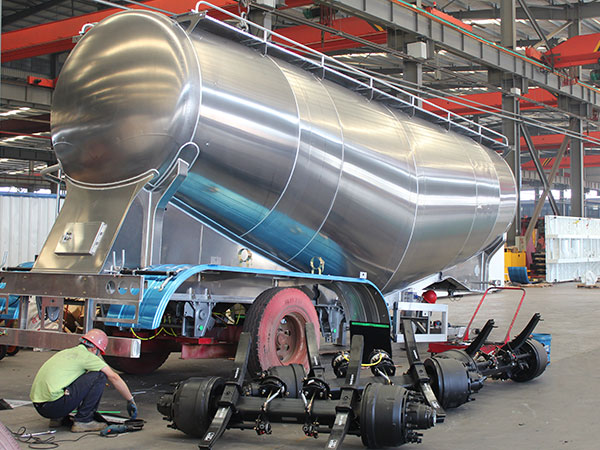
Trailer manufacturing involves tank fabrication, structural welding, chassis assembly, pneumatic equipment installation, surface treatment, and final inspection.
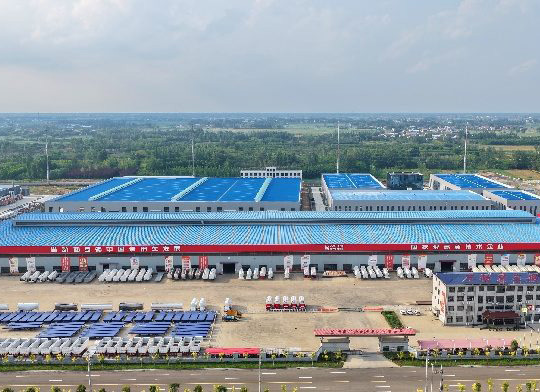
YOUCAN's semi-trailer manufacturing facility includes production processes such as cutting, welding, surface preparation, painting, and assembly.
For a flour tanker project, buyers should discuss the proposed tank structure, food-contact materials, internal finish, discharge equipment, and cleaning accessibility before confirming the design.
The manufacturer's ability to produce a structurally reliable trailer must be evaluated separately from its ability to meet the hygiene requirements of food transportation.
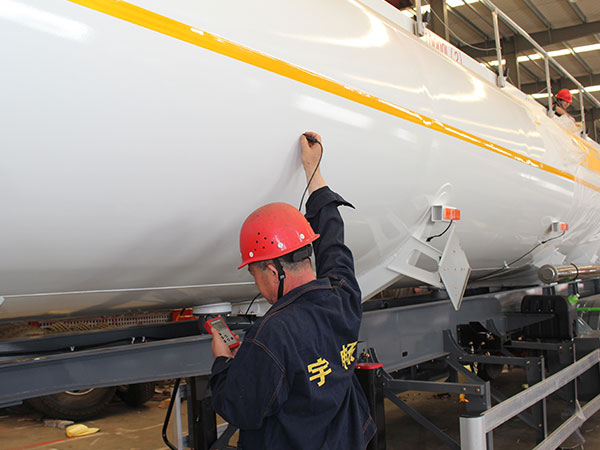
Quality Control and Technical Verification
A flour tanker trailer requires reliable structural components and a properly specified pneumatic system.
Before delivery, important inspection items may include:
Tank dimensions and structural integrity
Welding quality and internal surface condition
Sealing and closure performance
Air lines, valves, and discharge connections
Pressure-related safety equipment
Axle, suspension, and braking components
Compatibility with the approved technical specification
YOUCAN outlines its manufacturing inspection approach on its quality control page.
For food transportation projects, buyers should additionally request evidence of food-contact suitability and any required hygiene-related testing or documentation. General trailer quality inspections do not replace these requirements.
Customization and Purchasing Requirements
When discussing a flour tanker trailer, buyers should provide the following information:
Flour type and expected bulk density
Required payload and delivery volume
Preferred tank configuration
Destination country and applicable regulations
Loading and unloading connection specifications
Food-contact material requirements
Cleaning and contamination-control procedures
Tractor specifications and road conditions
These details help determine whether a suitable design can be supplied and what technical verification is necessary.
For product inquiries and project-specific requirements, contact YOUCAN Trailer to discuss the proposed configuration and confirm the availability of food-grade flour transport solutions.
FAQs About Flour Tanker Trailers
What Is the Typical Capacity of a Flour Tanker Trailer?
Flour tanker trailers can be designed with different tank volumes depending on transportation requirements.
The appropriate capacity depends on flour bulk density, usable tank volume, trailer tare weight, legal payload, and route restrictions.
Buyers should calculate the expected cargo weight and confirm the approved vehicle specifications before selecting a tank size.
What Are the Standard Dimensions of a Flour Tanker Trailer?
There is no universal set of dimensions for every flour tanker trailer.
Overall length, width, and height vary with tank capacity, tank geometry, axle arrangement, and the destination country's vehicle regulations.
Buyers should request a dimensioned technical drawing for the specific model being considered.
Can a Cement Tanker Trailer Be Used to Transport Flour?
A conventional cement tanker should not be assumed suitable for flour transportation.
Flour is a food ingredient, so the tank, seals, piping, conveying-air system, and other product-contact components must meet the applicable hygiene and food-contact requirements.
A tanker previously used for cement or other non-food materials may present contamination risks and should not be repurposed for food transport without appropriate professional assessment and regulatory compliance.
Which Is Better: a Vertical or Horizontal Flour Tanker Trailer?
Neither design is universally better.
A vertical-compartment design can use sloping surfaces to guide flour toward discharge outlets, while a horizontal design may rely more heavily on fluidization equipment.
The preferred configuration depends on the flour's flow properties, residual material requirements, cleaning accessibility, unloading performance, and operating conditions.
How Much Does a Flour Tanker Trailer Cost?
The purchase price depends on tank capacity, construction materials, axle configuration, pneumatic equipment, hygienic design requirements, and customization.
Food-contact material specifications, cleaning features, and any required testing or documentation may also affect the final cost.
For an accurate quotation, buyers should provide a complete technical specification and confirm the manufacturer's ability to meet the intended food-transport requirements.
3 Axle Low Loader Trailer will be sent to Sierra Leone
At Yuchang Trailer, We supply lowbed trailers for all types of mechanical equipment, construction equipment and machinery.
Read More →
Daily maintenance of fuel tanker
A tanker trailer is a heavy-duty truck-trailer to carry fuel, gas, chemical tank, cement, liquid, bulk goods and more.
Read More →