
Choosing Tandem or Tri-Axle 40ft Container Chassis
For container operators, the choice between tandem and tri-axle running gear directly affects legal payload, maneuverability, tire cost, and route flexibility. A 40ft container chassis with tandem axles is generally suited to standard container movements where axle-load limits and gross combination weight remain manageable. A tri-axle design provides additional load distribution for heavier cargo, demanding road regulations, and higher-capacity operations.
The correct specification should be based on the container’s maximum gross weight, local axle-load law, fifth-wheel position, terminal conditions, tractor configuration, and expected annual mileage. Buyers should compare complete operating cost rather than selecting solely by purchase price.

1. Executive Summary and Quick Comparison Table
Tandem and tri-axle chassis use the same basic purpose-built frame to transport ISO containers, but their running gear produces different performance characteristics. Tandem-axle units usually offer lower tare weight, fewer wear components, and easier cornering. Tri-axle units add a third axle to improve load sharing and help operators comply with restrictive axle-load regulations when hauling heavy 40-foot containers.
| Comparison Item | Tandem-Axle Chassis | Tri-Axle Chassis |
|---|---|---|
| Key Specs | Two axles, typically lower tare weight and shorter axle group | Three axles, wider load distribution and higher running-gear capacity |
| Working Mechanism | Container load transfers through frame, suspension, and two axle assemblies | Container load transfers through frame, suspension, and three axle assemblies |
| Speed and Precision | Better low-speed maneuverability and reduced tire scrub | Stable load support but greater turning resistance in tight yards |
| Cost Level | Lower initial cost and fewer replacement components | Higher purchase cost due to extra axle, wheels, brakes, and suspension parts |
| Maintenance | Lower tire, brake, bearing, and suspension service requirement | More inspection points and potentially higher tire wear in severe turning conditions |
| Ideal Application | Standard-weight containers, regional transport, ports with practical weight limits | Heavy cargo, dense commodities, strict axle-load regions, high-capacity fleets |
For buyers building a broader fleet, compatible Container Chassis specifications should be standardized around local tractor dimensions, road permits, and maintenance inventory.
2. Understanding Tandem-Axle Chassis
Overview and operating principle
A tandem-axle chassis uses two closely positioned trailer axles beneath the rear section of the frame. The container is secured by twist locks, while the structural frame transfers vertical load through the suspension equalizer or air-suspension system to both axles. Common configurations include mechanical leaf-spring suspension, air suspension, drum brakes, or disc brakes depending on the market.
This arrangement is the conventional choice for many container transport fleets because it balances purchase cost, maneuverability, and service simplicity. Its suitability depends on whether the legal axle group rating can support the expected cargo density.
Advantages
- Lower tare weight: Fewer axles and associated components can increase available payload where gross vehicle limits permit.
- Lower acquisition cost: The chassis requires fewer wheels, tires, brake assemblies, hubs, and suspension parts.
- Simpler maintenance: Daily and periodic inspections cover fewer moving components.
- Improved maneuverability: A shorter axle group generally creates less tire scrub during tight terminal turns.
- Efficient for standard freight: Well suited to general merchandise, lighter industrial goods, and balanced container loads.
Potential limitations
- Lower load distribution: Each axle may carry a greater share of the load than in a three-axle arrangement.
- Route restrictions: Heavy 40-foot containers may exceed legal axle loads in some countries or states.
- Less flexibility for dense cargo: Metal products, machinery, stone, chemicals, and other dense freight may require additional axle capacity.
3. Understanding Tri-Axle Chassis
Overview and operating principle
A tri-axle chassis incorporates three axle assemblies under the rear frame. The added axle spreads the trailer load over more tire contact points and braking components. Depending on the design, the unit may use mechanical suspension, air suspension, lift-axle functionality, or a fixed three-axle configuration.
The design is commonly selected for heavy containerized cargo and operations where road authorities enforce strict axle-group loading. A third axle does not automatically increase legal gross combination weight; it primarily improves the distribution of permitted load. Buyers must still verify national and local transport rules.
Advantages
- Improved axle-load distribution: Three axles can reduce the calculated load carried by each axle.
- Better heavy-cargo suitability: Appropriate for dense freight profiles and heavy ISO containers within applicable legal limits.
- Higher braking component capacity: The additional axle adds brakes and tires, supporting controlled load handling when correctly specified.
- Operational compliance support: Can help fleets meet axle-load requirements on regulated transport corridors.
- Fleet flexibility: A practical choice when container weights vary significantly between shipments.
Potential limitations
- Higher capital cost: The third axle increases material, assembly, and equipment cost.
- Higher operating expense: More tires, brake linings, wheel bearings, and suspension bushings require service.
- Increased tire scrub: Fixed tri-axle groups can create more lateral tire wear during sharp turns.
- Higher tare weight: Additional running gear may reduce payload margin where gross vehicle weight is fixed.
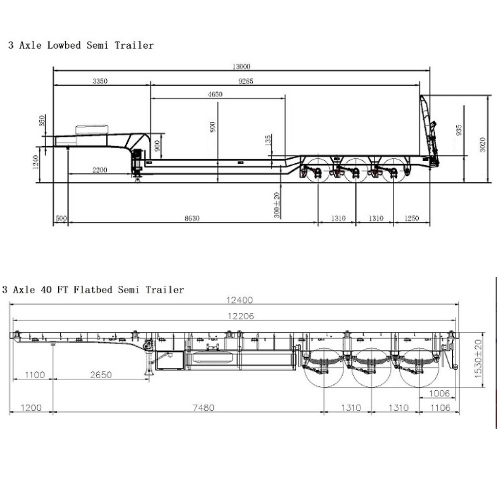
4. Core Differences Between Tandem and Tri-Axle Designs
Performance and output quality
For a transport chassis, performance is measured by load stability, legal carrying capability, braking response, tire behavior, and uptime rather than production speed. Tandem units generally perform efficiently in repetitive port-to-warehouse movements with standard loads. Their lower resistance during turns can be valuable in congested depots and container yards.
Tri-axle units provide a stronger platform for heavy-duty duty cycles because the load is shared across three axles. However, performance depends on correct suspension equalization, axle alignment, tire inflation, and frame design. Poor alignment can quickly offset the theoretical benefit by accelerating tire wear.
Versatility and industry suitability
Tandem chassis are commonly used for consumer goods, packaged cargo, textiles, electronics, and general industrial products. They are particularly practical where container weights are predictable and roads allow the intended axle loading.
Tri-axle configurations are better suited to heavy machinery, metal products, mineral-based goods, dense packaged cargo, and project logistics. They may also be preferred for fleets working across regions with conservative axle-load enforcement. Operators needing open-deck transport for non-containerized freight may also compare suitable Flatbed Trailers for their wider cargo program.
Cost analysis
The upfront cost of a tandem unit is usually lower because it has fewer axles, wheels, tires, brake chambers, hubs, and suspension components. It can also offer lower recurring costs for tire replacement and workshop labor.
A tri-axle model typically costs more to purchase and maintain. Its commercial value comes from avoiding axle overload risks, reducing the need to reject heavy loads, and improving route eligibility. Procurement teams should calculate total cost using expected payload utilization, annual distance, tire replacement intervals, permit costs, downtime exposure, and local penalties for overloaded axles.
Lifespan and daily maintenance requirements
Both designs can provide long service life when built with appropriate high-strength steel, corrosion protection, certified axles, and correctly matched suspension. Lifespan is strongly affected by overloading, poor road conditions, coastal corrosion, braking habits, and maintenance discipline.
Daily inspections should include tire pressure, wheel-nut condition, brake air leaks, suspension damage, twist-lock operation, lighting, landing gear, and visible frame cracks. Tri-axle units require the same checks across more components. Periodic axle alignment is especially important for all multi-axle trailers operating in tight terminals.
5. Decision Matrix for Selecting the Right Configuration
Choose a tandem-axle chassis if
- Your freight is predominantly standard-weight and does not approach axle-load limits.
- Your operation requires frequent tight turning in ports, depots, and urban delivery sites.
- Lower purchase cost and reduced maintenance inventory are primary procurement objectives.
- Your fleet values lower tare weight and the applicable regulations allow the required payload.
- Your routes have reliable road surfaces and predictable container weight profiles.
Choose a tri-axle chassis if
- You regularly move heavy 40-foot containers or dense cargo.
- Axle-load regulations are strict and a third axle is needed for compliant load distribution.
- Your business serves multiple industries with widely varying cargo weights.
- You prioritize heavy-duty capacity over minimum purchase price.
- Your route planning can accommodate the larger turning radius and added tire wear risk.
Decision-makers should request axle-load calculations using actual tractor weight, fifth-wheel height, kingpin setting, container center of gravity, suspension spacing, and applicable road regulations. This is more reliable than selecting based only on nominal trailer capacity.
6. Customization Options for OEM and ODM Orders
Container chassis can be configured for regional regulations, fleet operating procedures, and container-handling equipment. Important customization should be confirmed in technical drawings before production begins.
- Frame configuration: Fixed, extendable, skeletal, gooseneck, straight-beam, or reinforced designs.
- Axle and suspension selection: Tandem or tri-axle layouts, mechanical suspension, air suspension, lift axles, and different axle ratings.
- Container locking system: Fixed or retractable twist locks for 20-foot, 40-foot, and selected 45-foot container applications.
- Brake specification: Drum or disc brakes, ABS/EBS compatibility where required, and market-specific air-line connectors.
- Electrical system: LED lamps, required reflector arrangements, and voltage or connector standards for the destination market.
- Surface protection: Sandblasting, epoxy primer, polyurethane topcoat, galvanizing options, and fleet-color branding.
- Fleet equipment: Toolboxes, spare-wheel carriers, mudguards, rear bumpers, GPS mounting provisions, and identification plates.
For fleets operating several trailer categories, standardized components can simplify spare-parts planning across Interlink Trailers, chassis units, and other transport equipment.
7. Packaging and Shipping Guidance
Export preparation should protect the chassis against salt exposure, vibration, moisture, and handling damage during inland transfer and sea transport. Because chassis are large rolling units, they are commonly shipped as complete built-up trailers, partially disassembled units, or in nested arrangements where design and shipping regulations permit.
Export-standard protection may include rust-preventive coating on exposed machined surfaces, waterproof wrapping for electrical parts, anti-vibration padding around sensitive components, secured loose accessories, and clearly marked shipping documentation. Fumigation-free wooden cases are suitable for boxed spare parts, tool kits, and detachable accessories.
Before shipment, buyers should confirm shipping dimensions, lashing points, port handling requirements, customs documentation, destination homologation requirements, and whether wheels, landing gear, or accessories require special protection. A pre-shipment inspection should verify VIN or chassis numbering, paint condition, lighting operation, twist-lock engagement, and included spare parts.
8. Why Source From a Manufacturing Partner
A capable chassis manufacturing partner should provide more than welded steel structures. The supplier should be able to support engineering review, material traceability, jig-controlled fabrication, axle and suspension matching, coating inspection, load-related design verification, and export documentation.
Evaluate production capability by reviewing welding procedures, multi-line production capacity, dimensional inspection processes, paint-system controls, supplier qualifications for axles and braking systems, and the availability of replacement Trailer Parts. Where required by the destination market, buyers should also request applicable ISO quality documentation, CE-related declarations where legally relevant, and component certificates.
Global technical support should include drawing confirmation, remote assembly guidance, maintenance manuals, spare-parts identification, and practical responses to regional operating conditions. For mixed fleets, manufacturers can also coordinate specifications alongside equipment such as an Interlink Flatbed Trailer to improve parts commonality and workshop efficiency.
9. Frequently Asked Questions
Can a tandem-axle chassis be upgraded to a tri-axle configuration later?
Sometimes, but it is not usually a simple axle addition. The frame, suspension mounting points, brake system, electrical system, landing gear loading, and legal approval may all require redesign. Ordering the correct configuration at the start is normally more economical and easier to certify.
Which option provides a faster return on investment?
A tandem unit can provide faster ROI for standard-weight freight because its purchase and maintenance costs are lower. A tri-axle unit can provide better ROI when it enables legally compliant movement of heavier containers, reduces rejected loads, or avoids the need for additional trips.
Does a tri-axle configuration always permit a higher legal payload?
No. Legal payload depends on national and local gross vehicle weight limits, axle-group limits, tractor configuration, axle spacing, fifth-wheel position, and cargo distribution. A third axle improves load sharing, but it does not override legal gross-weight restrictions.
Which suspension is better for container transport?
Mechanical suspension is often selected for simplicity, durability, and lower acquisition cost. Air suspension can provide improved ride control and easier height management, but it has more components and requires disciplined maintenance. The best choice depends on road conditions, cargo sensitivity, and service capability.
How often should axle alignment be checked?
Alignment should be checked after impact damage, abnormal tire wear, suspension repair, axle replacement, or repeated operation on poor roads. Many fleets also include alignment verification in scheduled preventive maintenance to protect tire life and fuel efficiency.
Request a custom axle-load review and quotation for your container transport routes.
Improve Intermodal Turns With a 40ft Container Chassis
Discover how a 40ft container chassis optimizes logistics, port drayage, and supply chain efficiency. Learn key specs and applications. Request a tech...
Read More →
How to Source an Interlink Flatbed Trailer From an OEM
Sourcing an interlink flatbed trailer? Review specs, QC, OEM options, packaging and FAQs in this buyer checklist, then send drawings for a quote.
Read More →