
 WhatsApp
 sales@youcantrailer.com
 +8615203709888
Bulk cement tanker production
A bulk cement tanker looks like a simple steel tank on wheels, but building one properly takes careful welding, pressure testing and a well-planned air system. This article walks through what a bulk cement trailer does, how it works, what goes into making one, and how we hand a finished unit over to a customer.
What Is a Bulk Cement Trailer?
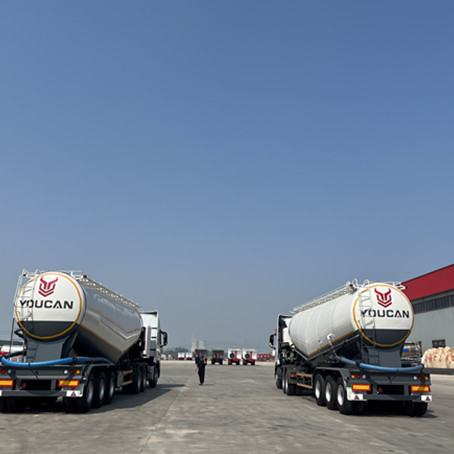
A bulk cement trailer is a sealed tank semi-trailer made for carrying dry powder in bulk instead of in bags. People also call it a cement tanker, a powder tanker or a pneumatic trailer. Besides cement, it is used for fly ash, lime powder, mineral powder, flour and other fine dry materials, as long as the particles are smaller than about 0.1 mm.
You will mostly see these trailers working between cement plants, storage warehouses and large construction sites. Hauling cement loose, rather than in 50 kg bags, saves a lot of labour at both ends. Nobody has to stack bags onto a truck or tear them open on site, and there is much less dust and waste along the way. That is the main reason bulk transport has taken over wherever cement is used in large volumes.
If you want to compare sizes and layouts before reading further, the range of bulk cement trailers is a good place to start.
How a Cement Tanker Unloads
The clever part of a cement tanker is that it unloads itself. It does not tip, and nobody needs to shovel anything. It uses compressed air.
Here is the process in plain terms:
The trailer is connected to a power source. Most units use the tractor's engine, which drives an on-board air compressor through a power take-off (PTO) and a drive shaft.
The compressor sends air through pipes into a sealed air chamber at the bottom of the tank.
Inside the tank, a porous layer sits above that chamber. Air passing through it loosens the cement and lifts it slightly, so the powder behaves a bit like a liquid. This is called fluidization.
Once the pressure in the tank reaches its set value, the driver opens the discharge butterfly valve.
The loosened cement flows into the discharge pipe and is pushed to wherever it is needed, usually a silo or storage tower.
With this method, a cement tanker can push material up more than 15 metres vertically, and move it horizontally for more than 5 metres. That is enough to reach the top of most storage silos on a cement plant or a concrete batching site.
The Main Parts of the Tanker
Each part has a job, and a weakness in any one of them shows up quickly in daily use.
Tank. The sealed container that holds the powder. It must be strong enough to handle pressure during unloading and rigid enough to stay stable on the road. Steel tanks are common and affordable. Aluminum tanks are lighter, which can mean more payload per trip.
Air compressor and PTO. The compressor makes the air, and the PTO passes engine power to it. Together they are the heart of the unloading system.
Air piping. This covers the air intake, the distribution lines to the bottom of the tank, pressure relief, and extra air-blowing lines that clear leftover powder.
Discharge valve and outlet. A butterfly valve controls the flow, and the outlet connects to the customer's silo pipe.
Loading hatches. Cement is usually filled from the top through hatches that seal tightly, so moisture and rain stay out.
Chassis, axles and suspension. The tank sits on a frame with two to four axles, depending on the volume and local weight rules. Suspension can be mechanical leaf spring or air suspension.
Tank Shapes and Why They Matter
The shape inside the tank affects how much powder stays behind after unloading. Some tanks have a V-shaped bottom, where the cement slides toward the centre and drains well. Others use a flatter, wider design that offers more volume but needs more careful air distribution.
A good design aims for three things: fast unloading, little cement left over, and full use of the tank volume. Fast unloading saves time at the plant gate. Low residue means less wasted material and less cleaning. Efficient use of volume means more cement per trip. When you compare tankers, ask about all three, not only the stated capacity.
How We Build a Bulk Cement Tanker
Production follows a sequence, and each step is checked before the next begins.
1. Cutting and rolling. Steel or aluminum plates are cut to size and rolled into the tank shell. Accurate cutting makes the later welding much cleaner.
2. Welding the tank. Seams are welded carefully, because a bad weld can leak air or powder under pressure. This is where experience counts most.
3. Frame and running gear. The chassis, main beams, axles and suspension are assembled. For a three-axle cement tanker, for example, a strong steel main beam and heavy-duty axles carry the weight of a full load.
4. Installing the air system. The compressor connection, piping, air chamber, valves and discharge outlet are fitted and linked.
5. Pressure and leak testing. The finished tank is pressurised to check for leaks. We do this before any paint goes on, so any problem can be fixed properly.
6. Surface treatment and painting. The steel is cleaned, primed and painted to resist rust, which matters for trailers that will cross oceans on a ship and then work in humid or dusty places.
7. Fitting tyres and final inspection. Tyres, lights, brakes and fittings are installed, and the whole trailer goes through a final check, including the air system and valves.
8. Delivery to the port. After passing every inspection, the trailer is moved to the port, loaded and shipped to the customer.
Steel or Aluminum?
This is one of the most common questions from buyers.
A steel tank is usually cheaper to buy and easy to repair almost anywhere. It is heavier, so the trailer's payload is a little lower for the same legal weight limit.
An aluminum tank is lighter, so the trailer can carry more cement per trip. It costs more up front, but on long routes, or where weight limits are strict, the extra payload can pay for itself over time.
Some customers choose a mix, with an aluminum tank on a strong steel frame. Our aluminum bulk cement tank semi-trailers come in volumes such as 33–38 m³ and 38–44 m³, while the steel range runs from 28 m³ up to 71 m³.
Choosing the Right Size
Bigger is not always better. Here are a few practical points to consider:
Local weight limits. Your country may cap the total weight per axle or per vehicle. A huge tank you can only fill halfway is a waste.
Road conditions. Narrow or rough roads favour smaller, easier-to-handle trailers.
Your silo. Check the height and connection of the silo you will unload into, so the outlet and air pressure suit it.
Your tractor. Make sure the tractor has the right fifth wheel, enough power and a suitable PTO setup.
Trip length. Long routes often justify lighter aluminum tanks. Short routes between a plant and a nearby site may not.
A recent order for a customer in Vietnam was a 51 CBM cement tanker with three axles, 13-ton axles, a high-strength steel main beam and mechanical suspension. For a customer in Malaysia, we built a 4-axle 45 m³ steel and aluminum cement bulker with air suspension and ABS.
A Recent Order, From Enquiry to Shipping
One of our recent customers found us through a friend's recommendation. He had already bought equipment in this field, and his friend told him we were easy to work with. From the first price enquiry to placing the order, the conversation was quick and clear, and the customer was able to confirm tank volume, axle layout and discharge setup without long delays.
Once the order was confirmed, production started. After the powder tank trailer was built, the tank went through its pressure test, then the tyres were fitted and the trailer passed its final inspection. We also helped the customer book tickets to come and see the finished trailer, and then arranged transport to the port for loading and shipping.
For first-time importers, this kind of support is just as valuable as the trailer itself.
Looking After Your Cement Tanker
A cement tanker lasts many years if it is maintained properly. A few habits make a real difference:
Keep the tank dry. Moisture turns cement into lumps. Always close hatches properly and check the seals.
Clear the pipes after unloading. Blow out leftover powder so the lines do not clog.
Check valves and seals regularly. A worn seal wastes air and slows down unloading.
Inspect the compressor and PTO. Oil level, drive shaft and mounting bolts should be checked often.
Watch the running gear. Tyres, brakes, wheel nuts and suspension need the same attention as any heavy trailer.
Clean the tank when changing material. If you switch from cement to another powder, clean thoroughly first.
Why Work With a Direct Manufacturer
YOUCAN Trailer has been building semi-trailers since 1999 in Shangqiu, Henan, and we supply customers in Africa, Latin America, Southeast Asia and other regions. Buying from the maker means you can discuss the details directly: tank size, material, number of axles, discharge height, even where the air outlet is placed. Changes can be made before production starts, not after the trailer has arrived.
Frequently Asked Questions
What materials can a bulk cement trailer carry?Cement, fly ash, lime powder, mineral powder and similar dry powders with a particle size under about 0.1 mm.
Do I need a separate compressor?Most cement tankers use an on-board compressor driven by the tractor engine through a PTO, so no extra equipment is needed at the site.
How high can a cement tanker unload?It can lift material more than 15 metres vertically and move it more than 5 metres horizontally.
Is steel or aluminum better?Steel is cheaper and easy to repair. Aluminum is lighter and carries more per trip. The better choice depends on your route and weight limits.
Can the trailer be customised?Yes. Volume, number of axles, suspension, tank material and discharge layout can all be adjusted to your needs.
Get in Touch
If you are planning to buy a bulk cement tanker, send us the cement type, the volume you need, your country and the tractor you plan to use, and we will suggest a suitable configuration. You can reach the sales team through our contact page.