




When it comes to the logistics and transport of oversized, heavy, and industrial machinery, standard flatbed trailers often fall short. To handle monumental loads safely and comply with strict vertical clearance regulations, the
Whether you are operating a construction fleet, managing a mining project, or moving industrial transformers, understanding the engineering, configurations, and applications of a lowbed semi trailer is critical for optimizing your heavy transport operations. As global infrastructure projects expand and machinery grows heavier and more complex, choosing the right specialized transport equipment directly dictates project timelines, safety records, and overall operational profitability.
What Exactly Is a Lowbed Trailer and How Does It Work?
A lowbed trailer is a heavy-duty semi-trailer characterized by an exceptionally low deck height—often sitting just 400mm to 900mm off the ground. Unlike flatbed trailers where the deck sits high above the wheels, a lowbed utilizes a "dropped deck" design positioned between the gooseneck (which attaches to the tractor unit) and the rear wheel assembly.
This ultra-low deck configuration provides two massive operational advantages:
Lower Center of Gravity: By bringing the heavy cargo closer to the road surface, the trailer dramatically enhances lateral stability during transit, reducing rollover risks on highway curves and uneven terrain.
Superior Vertical Clearance: The low-profile platform allows exceptionally tall machinery to pass safely beneath low bridges, overpasses, utility lines, and tunnel clearances without violating legal height limits or requiring complex route detours.
To explore our diverse range of heavy-duty transport vehicles designed for international projects, you can browse our main
Key Structural Features and Engineering Design of a Lowbed Trailer
A high-performance lowbed trailer is built to withstand extreme mechanical stress and concentrated load points over hundreds of thousands of kilometers under harsh conditions. Its structural integrity relies on several critical engineering features:
High-Tensile Steel Framework: The main beams, side rails, and chassis crossmembers are fabricated using high-strength structural steel grades (such as Q345B, T700, or equivalent high-yield alloys). This provides exceptional yield strength, impact resistance, and superior bending resistance under maximum payloads.
Gooseneck Mechanism: The front section connects the trailer to the tractor's fifth wheel. Depending on the operational model, it can be a fixed gooseneck, a mechanical detachable gooseneck, or a hydraulic removable gooseneck (RGN). The RGN allows the front neck to detach entirely, resting the front deck flat on the ground for effortless front-end loading.
Heavy-Duty Axles and Suspension: Equipped with multi-axle configurations (ranging from 2 to 6 or more axles) paired with robust mechanical spring suspensions, heavy-duty bogie suspensions, or air suspensions. This ensures that massive weight is evenly distributed across all tires, protecting both the trailer and regional road infrastructure.
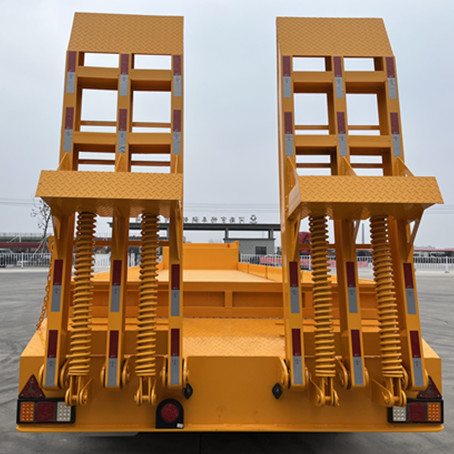
Integrated Ramp Systems: Rear-loading lowbed variants feature heavy-duty spring-loaded or hydraulic ramps with reinforced anti-skid surfaces, allowing tracked and wheeled heavy machinery to drive onto the deck safely and securely.
Advanced Braking and Safety Systems: Fitted with reliable pneumatic braking systems, emergency relay valves, and Anti-lock Braking Systems (ABS) to ensure stopping power under full heavy loads.
Main Types and Configurations of Lowbed Semi-Trailers
Lowbed trailers come in several distinct configurations to match specific cargo weights, dimensional profiles, and operational environments:
Fixed Gooseneck Lowbed: A rugged, cost-effective option where the gooseneck remains permanently fixed to the trailer deck. These trailers are typically loaded from the rear using ramps and are widely used for general construction machinery and medium-duty industrial transport.
Hydraulic Detachable Gooseneck (RGN) Lowbed: Widely considered the gold standard for heavy haulage. The front gooseneck detaches hydraulically via dedicated cylinders, allowing tall or heavy machinery (such as large excavators, pavers, and rollers) to drive straight onto the front deck at a very gentle incline. This eliminates the safety hazards associated with steep rear ramps.
Extendable and Telescopic Lowbed: Featuring an adjustable, telescoping deck length, these specialized trailers are engineered to haul exceptionally long industrial components, such as structural steel beams, industrial pressure vessels, and wind turbine tower sections.
Multi-Axle Modular Lowbed: Designed for extreme heavyweight transport (exceeding 80 to 150 tons), these trailers utilize multiple line axles, hydraulic steering dollies, and modular platforms to distribute massive loads across dozens of tires.
To learn more about how our robust engineering standards apply across different heavy-duty categories, you can also review our professional
Primary Applications: What Cargoes Do Lowbed Trailers Transport?
Due to their unmatched payload capacity, structural rigidity, and low deck profile, lowbed trailers are indispensable across multiple heavy industries worldwide:
Construction and Earthmoving Machinery: Transporting heavy excavators, bulldozers, wheel loaders, motor graders, asphalt pavers, and large mobile cranes to and from job sites.
Mining and Quarry Equipment: Moving massive underground mining trucks, heavy drill rigs, industrial crushing units, and mineral processing modules to remote, rugged mining locations.
Industrial and Energy Infrastructure: Hauling heavy electrical transformers, power station generators, industrial boilers, and prefabricated modular building units that require specialized clearance.
Agricultural and Forestry Machinery: Carrying oversized commercial tractors, combine harvesters, forestry feller bunchers, and logging equipment across regional highways and rural paths.
For liquid and bulk material transport needs that often complement large-scale industrial and construction sites, you can also explore our specialized
Why Choose a Lowbed Trailer Over Standard Flatbed Trailers?
When evaluating transport options for commercial fleets, logistics managers frequently weigh lowbed trailers against standard flatbed models. A lowbed trailer offers distinct operational superiority in heavy-duty scenarios:
Maximized Vertical Clearance: Standard flatbeds sit roughly 1.3 to 1.5 meters off the ground, making tall machinery illegal or impossible to transport under standard bridge heights. Lowbeds eliminate this barrier entirely.
Enhanced Safety and Stability: The dropped well design keeps the primary mass of the cargo close to the asphalt, dramatically lowering the center of gravity and minimizing sway during high-speed highway transit or sudden steering maneuvers.
Versatile Loading Methods: With hydraulic RGN options, heavy tracked vehicles with low ground clearance can be loaded quickly from the front without risking slippage or tipping over rear ramps.
Regulatory Compliance: Designed specifically to comply with complex bridge formula laws and international axle-load limits, allowing operators to maximize legal payload without incurring overloading fines.
Manufacturing Excellence and Customization Options at YOUCAN Trailer
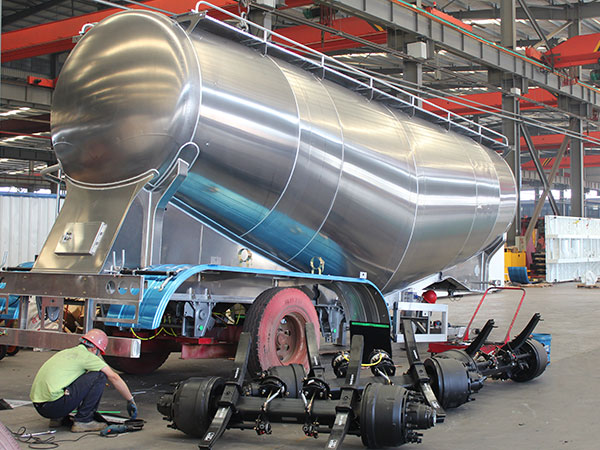
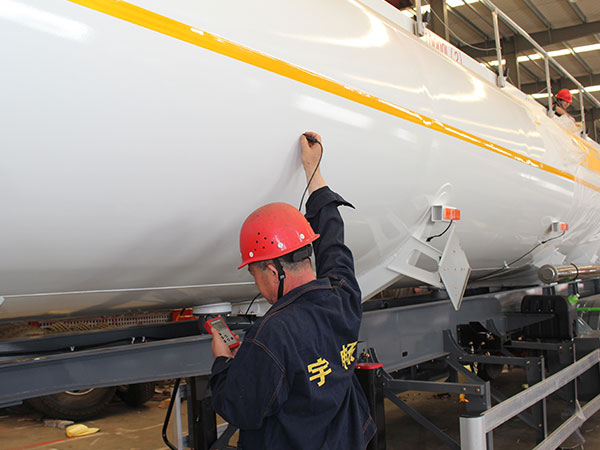
With over 28 years of manufacturing expertise since 1999, YOUCAN Trailer builds reliable, custom-engineered semi-trailers trusted by fleet owners and contractors in more than 50 countries across Africa, the Middle East, South America, and Southeast Asia. Every lowbed trailer undergoes rigorous laser cutting, automated precision welding, multi-layer shot blasting, anti-corrosion priming, and strict load-bearing inspections before leaving the factory floor.
We understand that every transport project has unique regional axle weight regulations, road conditions, and cargo dimensions. Our engineering team provides fully customizable configurations—including adjustable deck widths, drop-deck well lengths, trusted axle brands (such as FUWA or BPW), and specialized hydraulic ramp systems.
To discuss your specific project requirements or request a professional quotation from our engineering consultants, visit our
FAQ About Lowbed Trailers
1. What is the typical payload capacity of a 3-axle lowbed trailer?
Depending on the structural design, steel alloy grade, and local highway regulations, a standard 3-axle lowbed semi trailer typically handles payload capacities ranging from 40 to 60 tons, while specialized multi-axle configurations can safely carry over 100 tons.
2. What is the difference between a mechanical gooseneck and a hydraulic RGN lowbed?
A mechanical gooseneck requires manual locking pins and blocks to detach or adjust, making it a simpler, highly durable, and budget-friendly choice. A hydraulic detachable gooseneck (RGN) utilizes onboard hydraulic cylinders to quickly lower and detach the front neck, enabling fast front-end drive-on loading within minutes.
3. How is heavy machinery safely loaded onto a lowbed trailer?
Machinery is loaded either from the rear via heavy-duty spring-assisted or hydraulic ramps, or from the front by detaching the gooseneck on RGN models. Operators must verify correct weight distribution, engage parking brakes securely, and fasten the machine using heavy-duty grade 80 chain binders and ratchet tensioners.
4. Do lowbed trailers require special transport permits?
Yes. Because lowbed trailers frequently haul oversized, overweight, or out-of-gauge (OOG) industrial machinery, transport operators typically need special oversize load permits, pilot/escort vehicles, and must adhere to designated routes and travel time restrictions mandated by local transport authorities.
5. What is the standard production and delivery timeline for a custom lowbed trailer?
Standard lowbed configurations usually require about 20 to 30 working days for production after deposit confirmation. Fully customized multi-axle or hydraulic detachable gooseneck trailers may require a slightly extended lead time, which is confirmed with our clients prior to order finalization.

Lowbed Trailer Transported To Customers
At Yuchang Trailer, We supply lowbed trailers for all types of mechanical equipment, construction equipment and machinery.
Read More →
45000 Liters Fuel Tank Trailer
A tanker trailer is a heavy-duty truck-trailer to carry fuel, gas, chemical tank, cement, liquid, bulk goods and more.
Read More →